

How To Create A Plugin For Eclipse
This Tutorial describes how to extend the Eclipse IDE with custom plug-ins.
1. Extending the Eclipse IDE
The Eclipse platform and the Eclipse IDE is an extensible framework which allows to add additional functionality, remove or customize existing functionality.
Any download of the Eclipse IDE can be viewed as a special Eclipse application with the focus on supporting software development. An Eclipse application consists of individual software components, called plug-ins. For example, the Eclipse Java IDE provides the functionality to develop Java applications via the JDT plug-ins.
As Eclipse is build as an extensible framework, plug-ins can use and extend other plug-ins.
During development, you can start a new instance of the Eclipse IDE to test and debug your plug-ins. The new instance is sometimes called a runtime Eclipse or an inner Eclipse.
An easy way to start a runtime Eclipse is by selecting from the context menu of an plug-in or its manifest file. By default, this takes all the plug-ins from the workspace and the target environment, and start a runtime Eclipse with these plug-ins. If a plug-in is available in the workspace and the target environment, the one from the workspace is used.
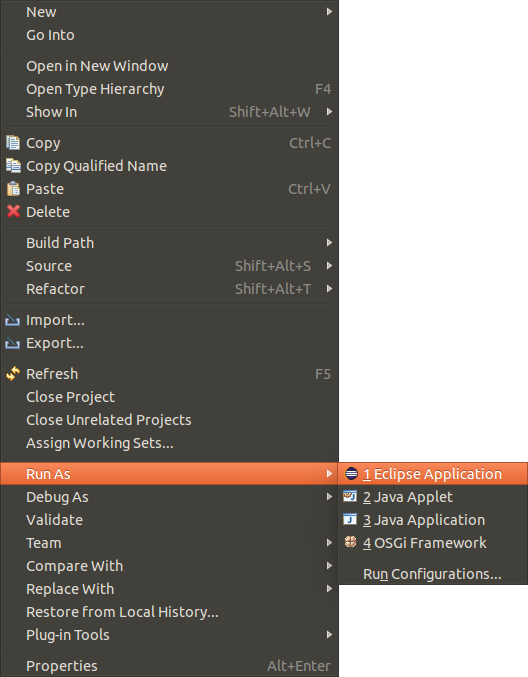
You can also debug the runtime Eclipse. Put a breakpoint in a line of the source code which you want to inspect, right-click your plug-in and select .
When the execution flow reaches a statement marked with a breakpoint, the execution stops, and you are able to debug the related statement, and to inspect the current data.
2. Download the Eclipse SDK
If you plan to add functionalities to the Eclipse platform, you should download the latest Eclipse release. Official releases have stable APIs, therefore are a good foundation for adding your plug-ins and features.
The Eclipse IDE is provided in different flavors. While you can install the necessary tools in any Eclipse package, it is typically easier to download the Eclipse Standard distribution which contains all necessary tools for plug-in development. Other packages adds more tools which are not required for Eclipse plug-in development.

| Eclipse provides also an Eclipse installer installer. The installer is useful, if you want to download several flavors of Eclipse. It uses a shared installation pool for common plug-ins, which reduces the required space. |
3. Run configurations
3.1. What are run configurations?
The runtime Eclipse is based on the select set of plug-ins. These plug-ins are selected via a runtime configuration. This runtime configuration can be specified via:
-
a set of plug-ins or features or
-
a product which is used to create or update a run configuration
A run configuration also defines the environment which will be used to execute a generic launch. For example, it defines arguments to the Java virtual machine (VM), plug-in (classpath) dependencies, etc.
| If you are starting an Eclipse runtime IDE for testing, and clear the workspace location the next run will prompt you to choose a workspace. |
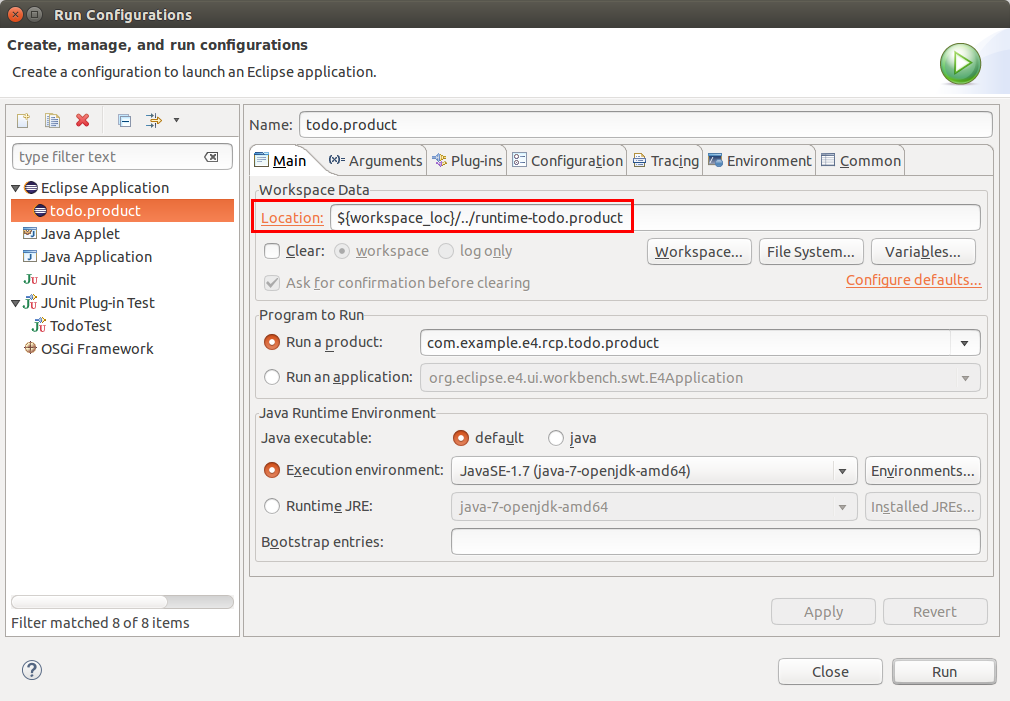
To review and edit your run configurations select from the Eclipse menu.
On the Main tab in the field Location, you specify where the configuration files for the runtime Eclipse are created.
3.2. Defining arguments
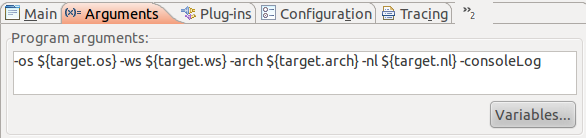
The run configuration allows you to add additional start arguments for your application on the Arguments tab. By default Eclipse includes already several parameters, e.g. parameters for -os,-ws and -arch to specify the architecture on which the application is running.
| To pass system properties to your Eclipse application, you can add launch parameters using the -D switch. As example, if you add the argument -Dmy.product.loglevel=INFO, you can get the "INFO" value with |
The following table lists several useful launch arguments.
| Parameter | Description |
|---|---|
| consoleLog | Error messages of the running Eclipse application are written to standard-out ( |
| nl | Specifies the locale used for your application. The locale defines the language specific settings, i.e., which translation is used and the number, date and currency formatting. For example -nl en starts your application using the English language. This is useful for testing translations. |
| console | Provides access to an OSGi console where you can check the status of your application. |
| noExit | Keeps the OSGi console open even if the application crashes. This allows to analyze the application dependencies even if the application crashes during startup. |
| clearPersistedState | Deletes cached runtime changes of the Eclipse 4 application model. |
3.3. Launch configuration and Eclipse products
If you are developing Eclipse RCP applications, the launch configuration is created based on the product configuration file. The launch configuration is updated every time you start your application via the product.
You can use the created run configuration directly for starting the application again. In this case changes in the product configuration file are not considered.
| Using an existing run configuration is a common source of frustration and time consuming error analysis. To ensure that you use the latest configuration from your product, start your application via the product file. |
3.4. Checklist for common launch problems
Errors in the run configurations of Eclipse RCP application are frequently the source of problems. This chapter describes common problems related to the start of RCP applications. It can be used as a reference in case you face issues during the startup of your application.
The most common problem is that some required plug-ins are missing in your product. If you are using a feature based product configuration, you need to ensure that all plug-ins which are referred to in the MANIFEST.MF file are also included in your features. This error is reported in the Console view, typically it is one of the first error messages and you need to scroll up to see it.
The following listing shows how this message typically looks like (formating changed to make the text fit better).
org . osgi . framework . BundleException : Could not resolve module: com . vogella . tasks . services [ 9 ] Unresolved requirement: Require - Bundle: com . vogella . tasks . events ; bundle - version = "1.0.0" After identifying the missing plug-ins ensure that you add them to your product (if the product is plug-in based) or to your features (if the product is feature based).
| Eclipse can check for missing dependencies automatically before you run the Launch configuration. On the Plug-ins Tab press the Validate Plug-ins button or select the Validate plug-ins automatically prior to launching option. This will check if you have all the required plug-ins in your run configuration. |
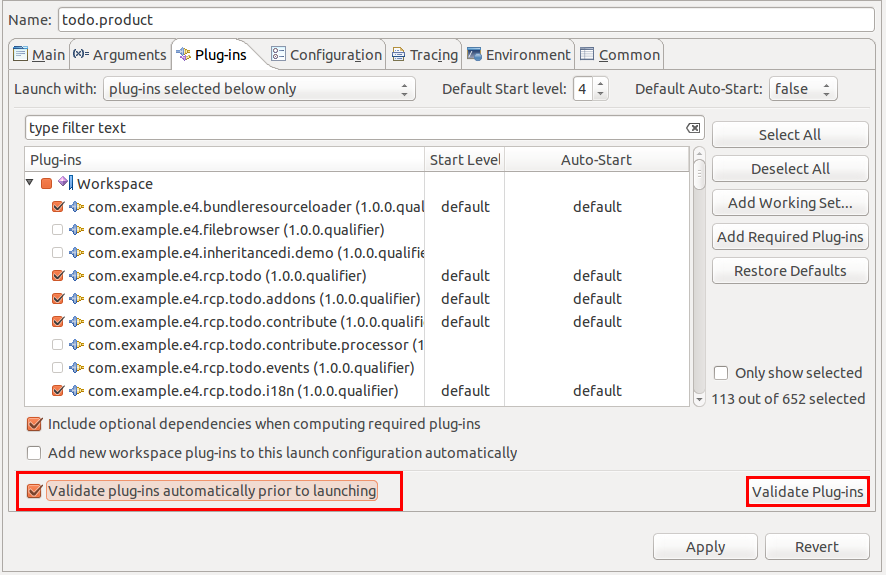
Avoid fixing problems with dependencies in the run configuration because the run configuration is created and updated based on the product configuration file. So always ensure that the product file is correctly configured instead of changing the derived information. The product configuration is used for the export of your product, hence an error in the product dependencies results in an exported application which cannot be started.
The following table lists potential problems and solutions.
| Problem | Investigate |
|---|---|
| "Could not resolve module" message during start up. | Check that all required plug-ins are included in your product configuration. Make sure that your product defines dependencies to all required plug-ins or features. See the beginning of this section for a description how to solve the problem. Bundles may also require a certain version of the Java virtual machine, e.g., a bundle may require Java 1.6 and will therefore not load in a Java 1.5 VM. Check the MANIFEST.MF file on the Overview tab in the Execution Environments section which Java version is required. |
| "java.lang.RuntimeException: No application id has been found." message during start up. | See "Could not resolve module" message during start up error. In most cases also triggered by a missing plug-in dependency. |
| Strange behavior but no error message. | Check if your run configuration includes the -consoleLog parameter. This option allows you to see errors from Eclipse based applications in the Console view of the Eclipse IDE. |
| Runtime configuration is frequently missing required plug-ins | Make sure that your product or your feature(s) includes all required dependencies. |
| A change in the product Dependencies tab is not reflected in the run configuration (e.g., a new plug-in is added but is not included in the run configuration) | A product updates an existing run configuration if you start the product directly from the product definition file. If you select the run configuration directly, it will not be updated. |
| Application model changes are not reflected in the Eclipse 4 application. | Eclipse 4 persists user changes in the application in a delta file which is restored at startup. During development this might lead to situations where model changes are not correctly applied to the runtime model, e.g., you define a new menu entry and this entry is not displayed in your application. Either set the Clear flag on the Main tab in your run configuration or add the clearPersistedState parameter for your product configuration file or run configuration. |
| Services, e.g., key bindings or the selection service, are not working in an Eclipse 4 application. | In Eclipse releases before 4.3 every part needed to implement a |
| Menu entries are disabled in the Eclipse application. | Ensure that the |
| Application "org.eclipse.ant.core.antRunner" could not be found in the registry or Application could not be found in the registry. | Ensure that you have pressed the New… button in the product configuration file and selected the |
| " Unresolved requirement: Require-Capability: osgi.extender; filter:='(&(osgi.extender=osgi.component)(version>=1.2)(!(version>=2.0)))' " message during start up or validation. | Add |
| "Event Admin service is not available, unable to publish event org.osgi.service.event.Event" message during start up. | Add |
4. Exercise: Creating and using a first plug-in
In this exercise you create an extension to the Eclipse IDE using a wizard.
4.1. Create a new plug-in project
Select to create a new plug-in.
Enter com.vogella.ide.first as name of the project.
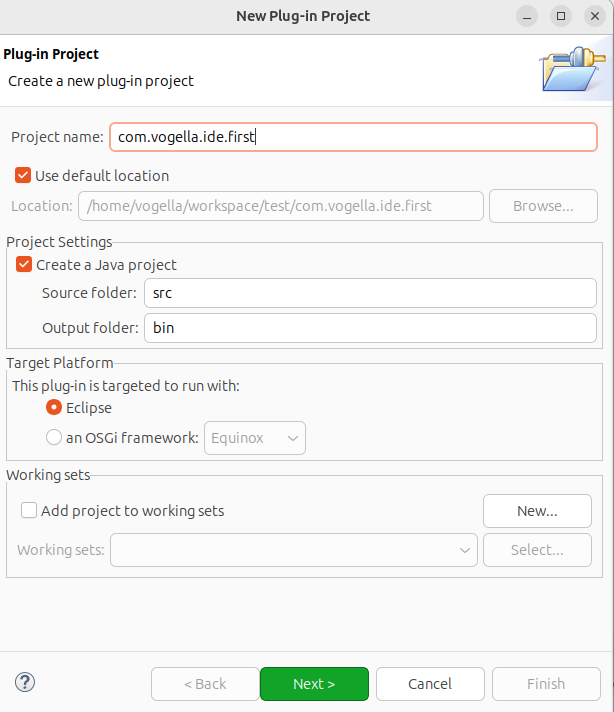
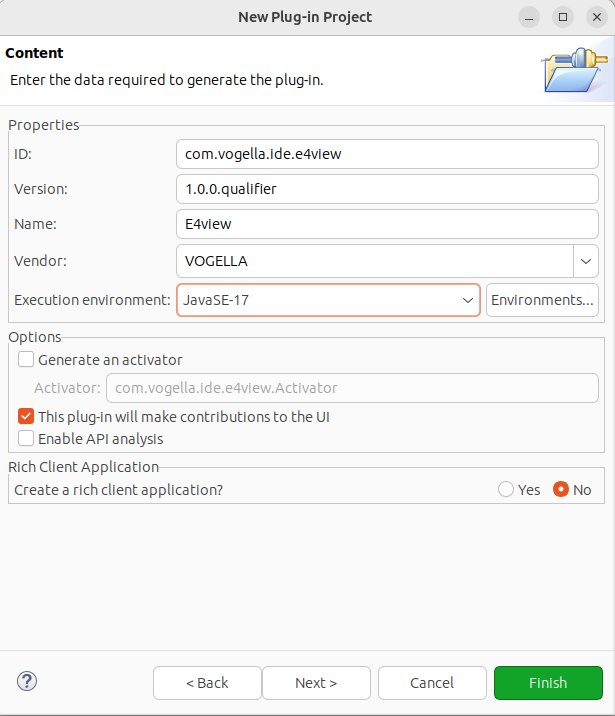
Press the Next button. On the next page enter the value as depicted on the following screenshot. Press the Next button.
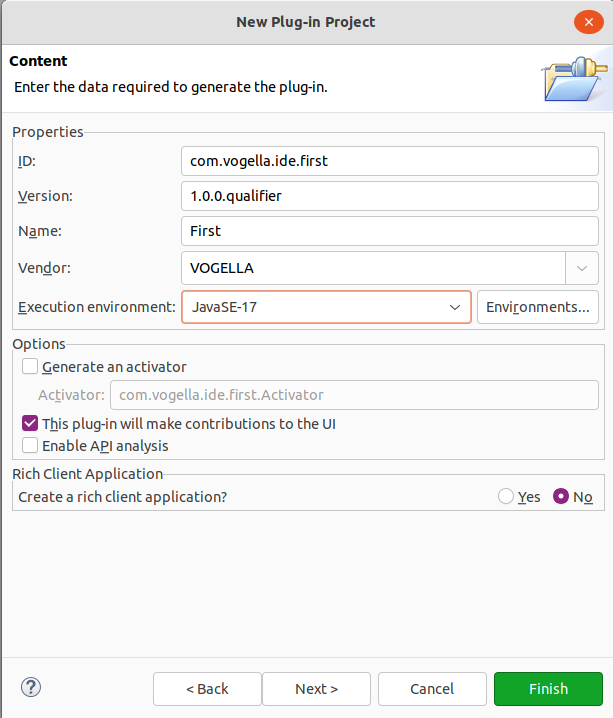
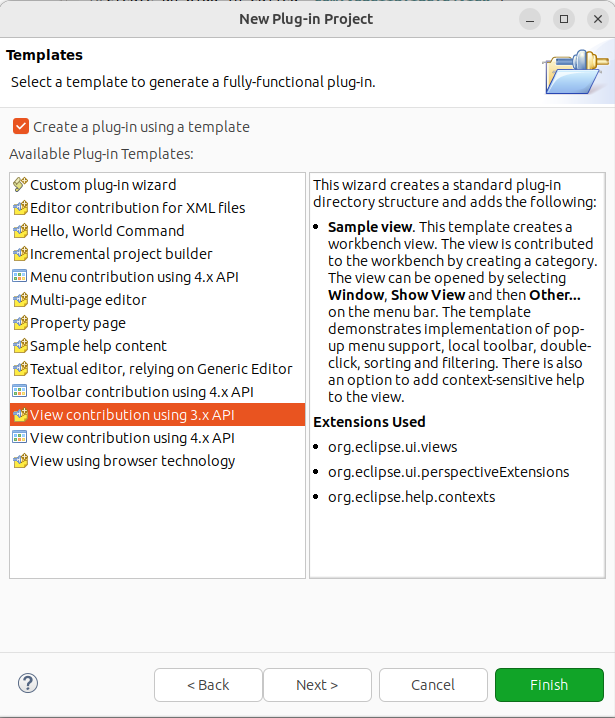
On the next page enable the Create a plug-in using one of the templates checkbox. Select the View contribution using 4.x API templates.
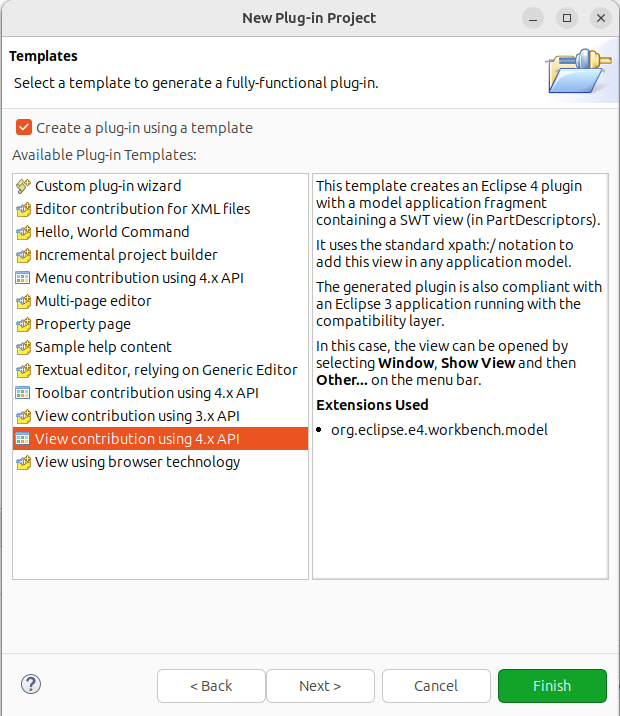
Afterwards, press the Next button or the Finish button.
If you pressed the Next, now press Finish, otherwise the following page is not shown.
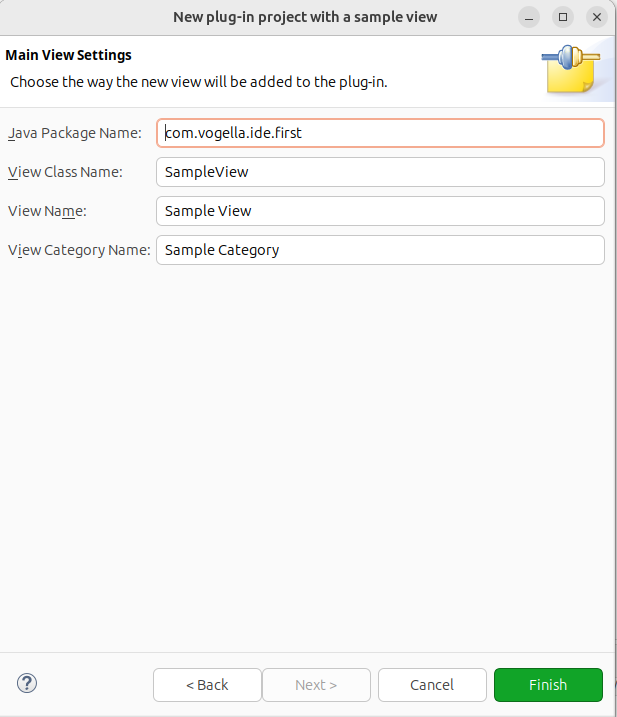
The wizard creates now a new plug-in using the selected template. Use the Project Explorer to review the generated files.
4.2. Start runtime Eclipse with your new plug-in
You now start a runtime Eclipse with your generated plug-in.
Start a runtime Eclipse with all plug-ins from your current target (your IDE) and your own plug-in. For this, right-click on your project and select .
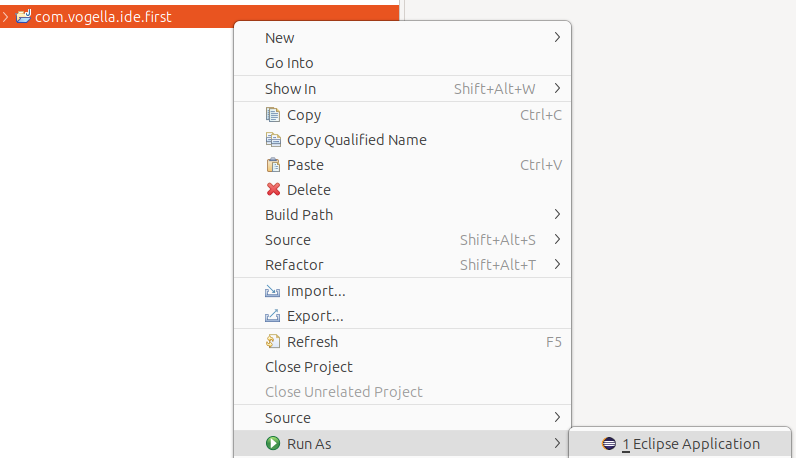
This starts a new runtime Eclipse which contains a new example view.
4.3. Validate result
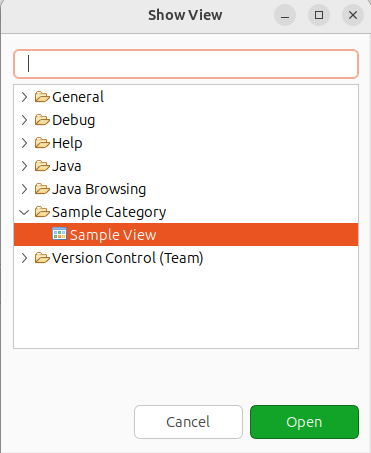
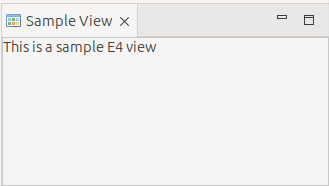
You should be able to open your Sample View view via the menu in your runtime IDE.
5. Using features and products to define your custom IDE
In this exercise you learn how to create features and products to configure and select the plug-ins selected for your runtime Eclipse.
5.1. Creating the feature
Create a new feature project called com.vogella.ide.feature via .
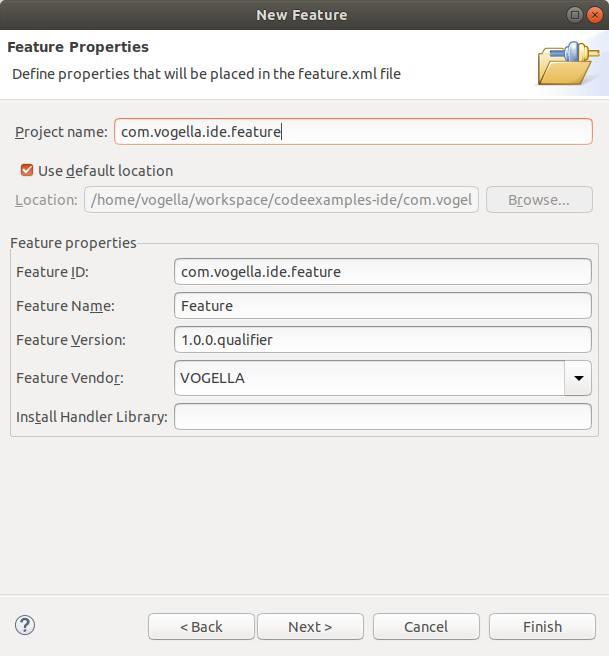
On the second page of the wizard, select the plug-in you want to add to the feature
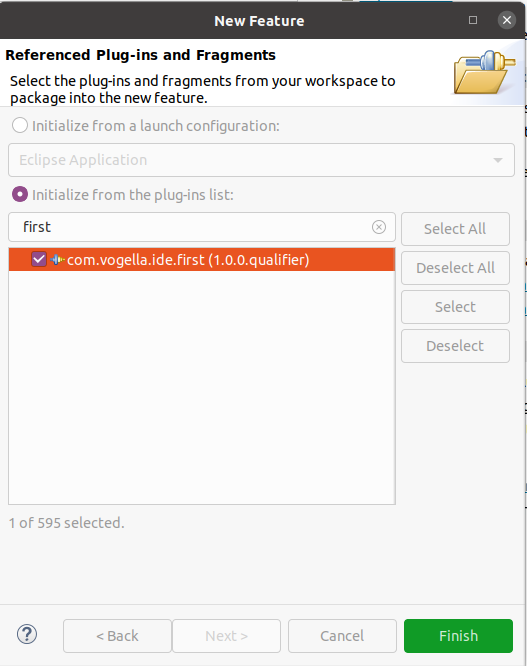
Press the Finish button afterwards.
5.2. Validate content of the feature
Open the feature.xml file. Afterwards select the Included Plug-ins tab in the editor and ensure that the desired plug-ins from your workspace are included into this feature.
| Ensure you have added the plug-in on the Included Plug-ins tab to include it into your feature. Using the Dependencies tab is wrong for this exercise. |
5.3. Create a project to host the product configuration file
Create a new project called com.vogella.ide.product via .
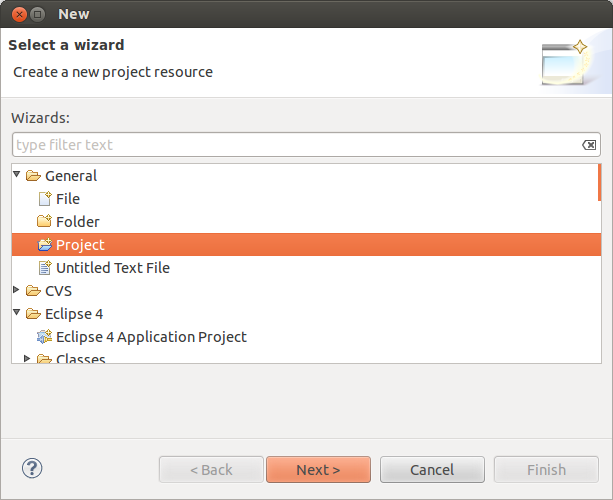
Enter the project name.
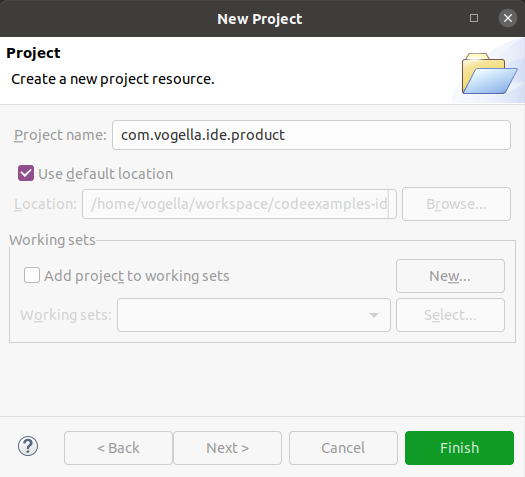
Press Finish.
5.4. Create a product configuration file
Right-click on this project and select .
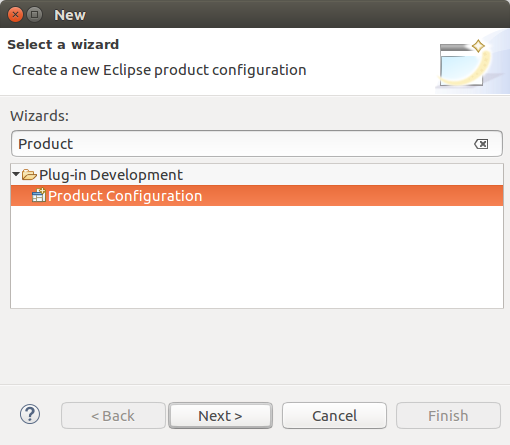
Create a product configuration file called ide.product inside your com.vogella.ide.product project folder.
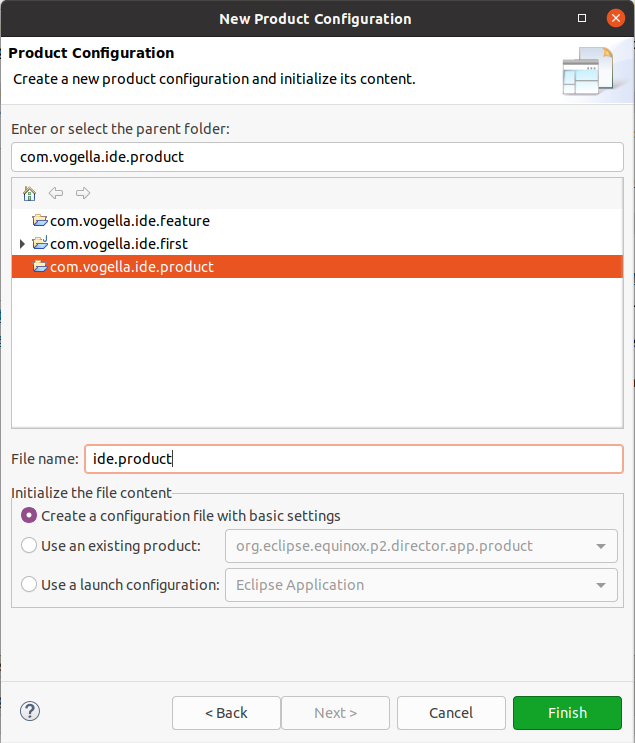
Press the Finish button.
A new product file is created and opened in an editor.
5.5. Configure your product
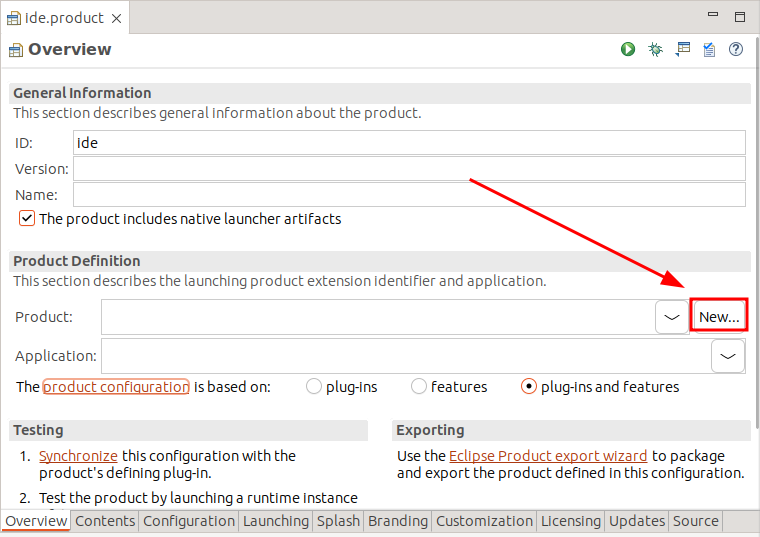
Ensure you have the product editor open for your new file. On the Overview tab of the product editor press the New… button.
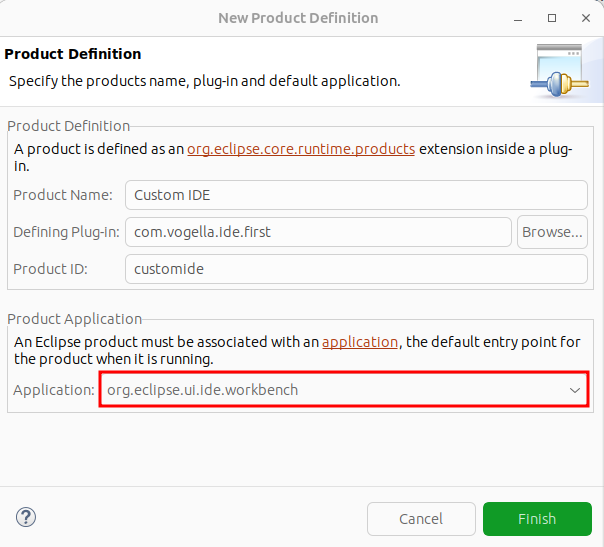
Enter the com.vogella.ide.first plug-ins as Defining Plug-in. Use org.eclipse.ui.ide.workbench as application. Use name and id similar to the following screenshot.
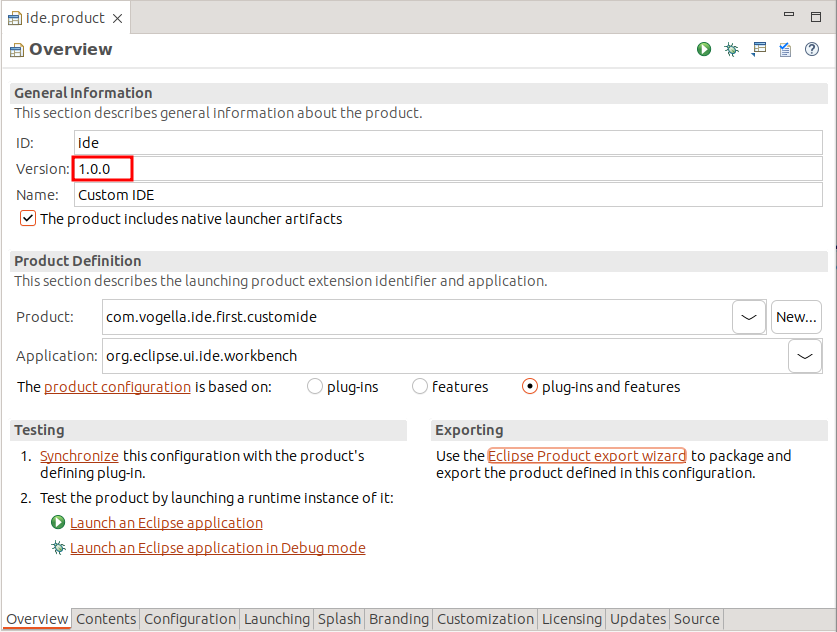
5.6. Enter version number
Enter the 1.0.0 version number into the product.
5.7. Enter includes features
Your product should be based on features. For this select the features option on the Overview tab.

Select the Contents tab and add the following features via the Add… button.
-
com.vogella.ide.feature -
org.eclipse.platform
Afterwards press Add Required button.
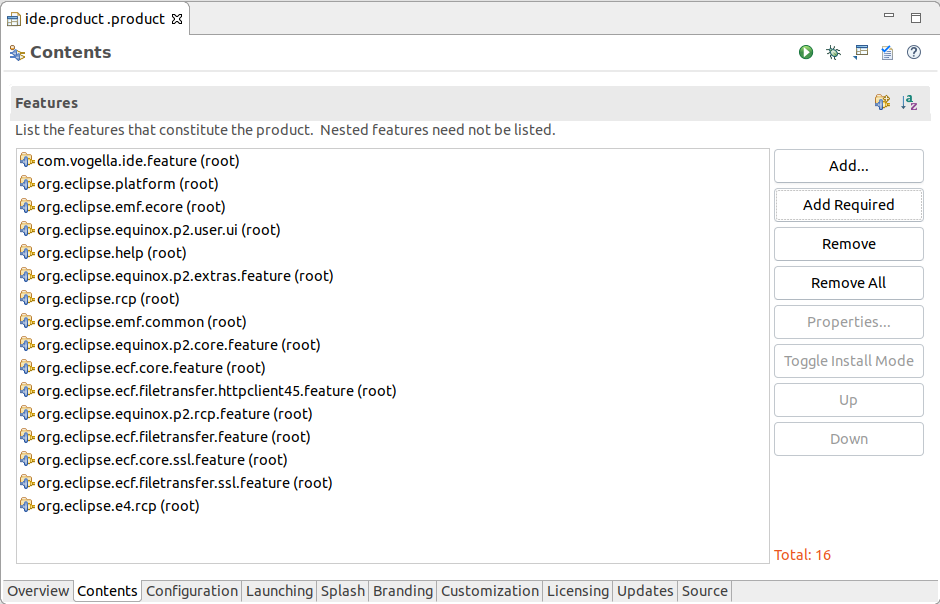
Save the ide.product file by pressing Ctrl S.
| If you cannot add one of the listed features to your product, ensure that your product configuration is based on features. |
5.8. Validate your setup by starting a runtime Eclipse
Select your product file and start the Eclipse IDE via the Run button.

As a result a runtime Eclipse IDE should start. It should contain only the features, which you have added to your product. For example, you should currently not be able to create a new Java project.
5.9. Add Java tooling to your IDE
Add org.eclipse.jdt.feature.group to your target platform. The target platform should look similar to the following listing.
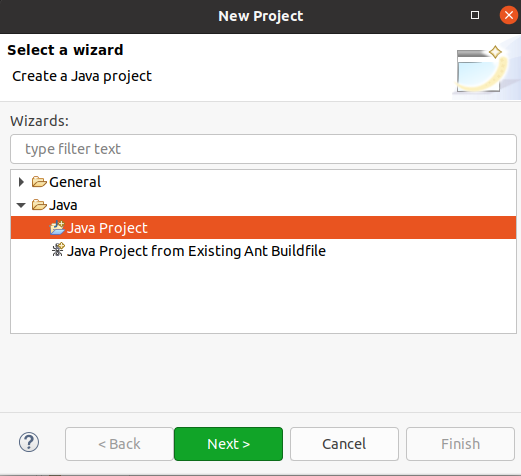
<?xml version="1.0" encoding="UTF-8" standalone="no"?> <?pde version="3.8"?> <target name= "target-platform" > <locations> <location includeAllPlatforms= "false" includeConfigurePhase= "true" includeMode= "planner" includeSource= "true" type= "InstallableUnit" > <repository location= "http://download.eclipse.org/releases/latest" /> <unit id= "org.eclipse.equinox.sdk.feature.group" version= "0.0.0" /> <unit id= "org.eclipse.platform.sdk" version= "0.0.0" /> <unit id= "org.eclipse.jdt.feature.group" version= "0.0.0" /> </location> </locations> </target> Afterwards, add the org.eclipse.jdt feature to your product and start a new runtime IDE via the product. Ensure that you now have the Java tooling installed, e.g., check via the new wizard, that you can create Java projects.
6. Exercise: Adding e4 part descriptors to 3.x based applications
In this exercise you add a model based part contribution to an Eclipse 3.x RCP application.
6.1. Adding a part descriptor
Create a simple plug-in named com.vogella.plugin.partdescriptor.
Add the following dependencies to your manifest file.
-
org.eclipse.core.runtime,
-
org.eclipse.jface,
-
org.eclipse.e4.ui.model.workbench,
-
org.eclipse.e4.ui.di
Create the following class
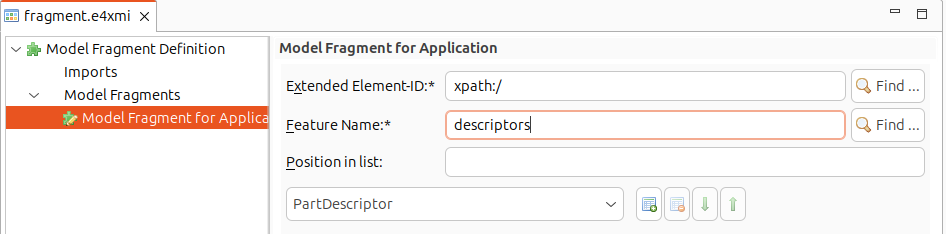
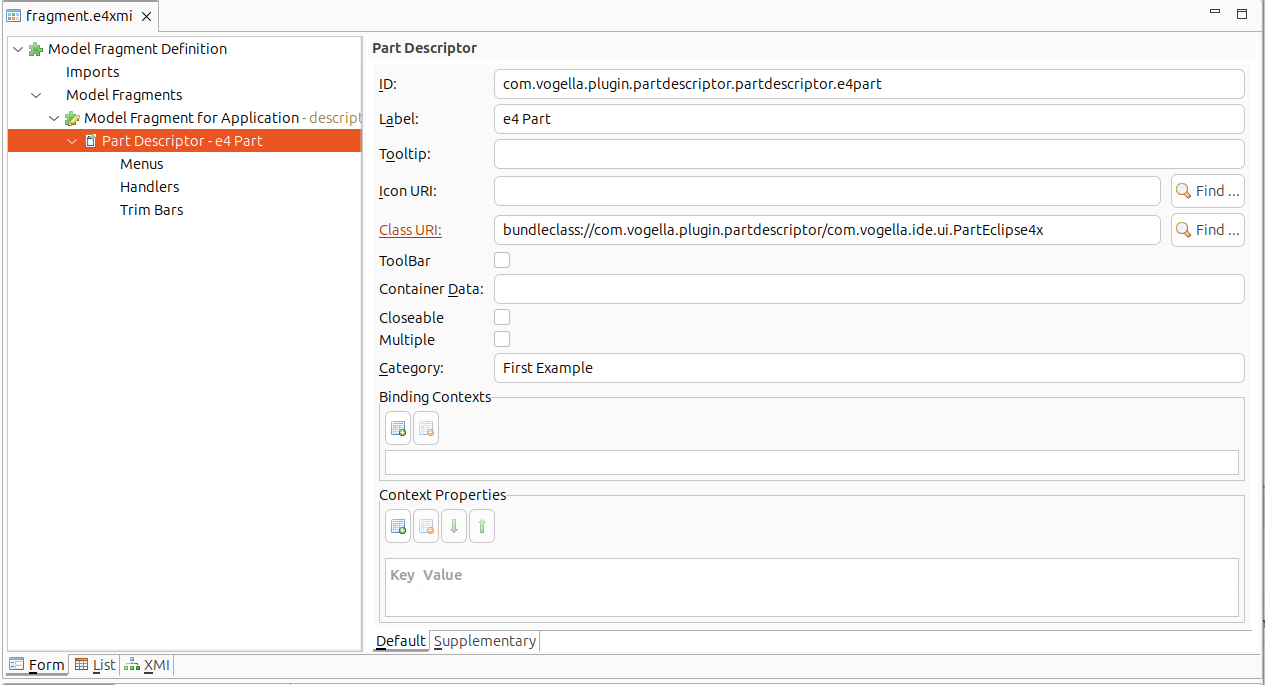
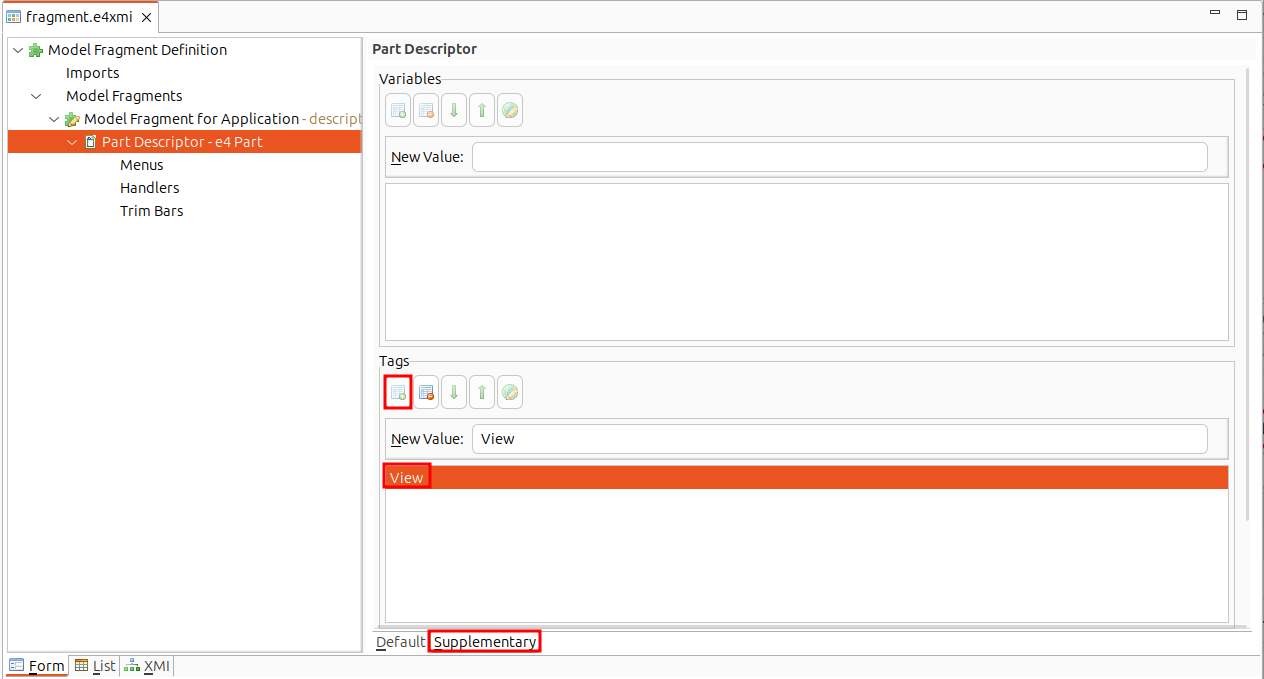
package com.vogella.ide.ui ; import javax.annotation.PostConstruct ; import org.eclipse.e4.ui.di.Focus ; import org.eclipse.jface.viewers.ArrayContentProvider ; import org.eclipse.jface.viewers.LabelProvider ; import org.eclipse.jface.viewers.TableViewer ; import org.eclipse.swt.SWT ; import org.eclipse.swt.widgets.Composite ; public class PartEclipse4x { private TableViewer viewer ; @PostConstruct public void createPartControl ( Composite parent ) { viewer = new TableViewer ( parent , SWT . MULTI | SWT . H_SCROLL | SWT . V_SCROLL ); viewer . setContentProvider ( ArrayContentProvider . getInstance ()); viewer . setLabelProvider ( new LabelProvider ()); viewer . setInput ( new String [] { "One" , "Two" , "Three" }); } @Focus public void setFocus () { viewer . getControl (). setFocus (); } } Add a new model fragment to this plug-in via .
6.2. Validate
Start an instance of the Eclipse IDE and validate that you can open the parts via the Quick Access box (shortcut CTRL+3 ).
You can also open the part via the menu entry.
7. Accessing the IEclipseContext from 3.x API
The Eclipse IDE uses the IEclipseContext data structure to store central information about the IDE. You can access this information also via the Eclipse 3.x API.
For example, to access the context from an Eclipse 3.x API view, you can use the following snippet.
// get the context of a part IEclipseContext partContext = getViewSite (). getService ( IEclipseContext . class ); // or access directly a value in the context based on its key EModelService service = getViewSite (). getService ( EModelService . class ); This snippet demonstrates the access via an Eclipse 3.x API handler.
// the following example assumes you are in a handler // get context from active window IEclipseContext windowCtx = HandlerUtil . getActiveWorkbenchWindow ( event ). getService ( IEclipseContext . class ); // get context from active part IEclipseContext ctx = HandlerUtil . getActivePart ( event ). getSite (). getService ( IEclipseContext . class ); 8. Contributing model elements to the Eclipse IDE or 3.x RCP applications
8.1. Adding Eclipse 4.x parts to Eclipse 3.x applications via the org.eclipse.ui.views extension point
You can also use a e4 part in an extension for the org.eclipse.ui.views extension point. Use the e4view entry in the context menu of the extension to archive this. The resulting object is created via dependency injection.
| For such a kind of view the existing toolbar and view extension point contributions do not work. To add for example a toolbar to your e4view, get the |
Menus, handlers and commands can be contributed to an Eclipse application via model fragments.
| You can use the model spy from the e4 tools project to identify the ID of the element you want to contribute too. |
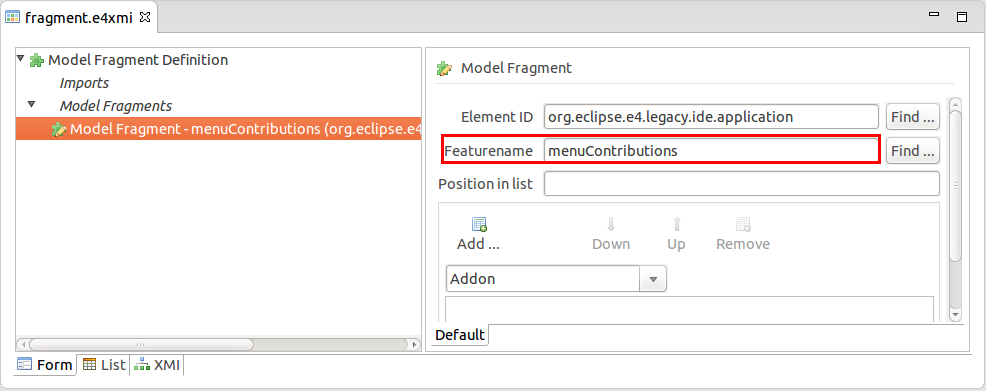
With the correct ID you can create model fragments that contribute to the corresponding application model element. The following screenshot demonstrate how to contribute to the menuContributions feature of the Eclipse IDE.
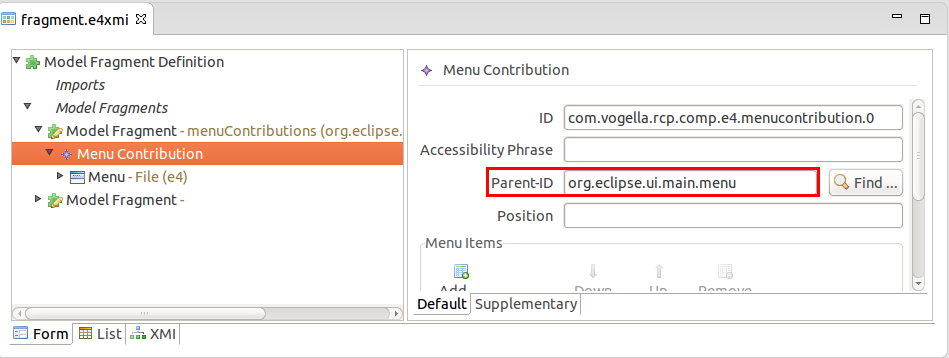
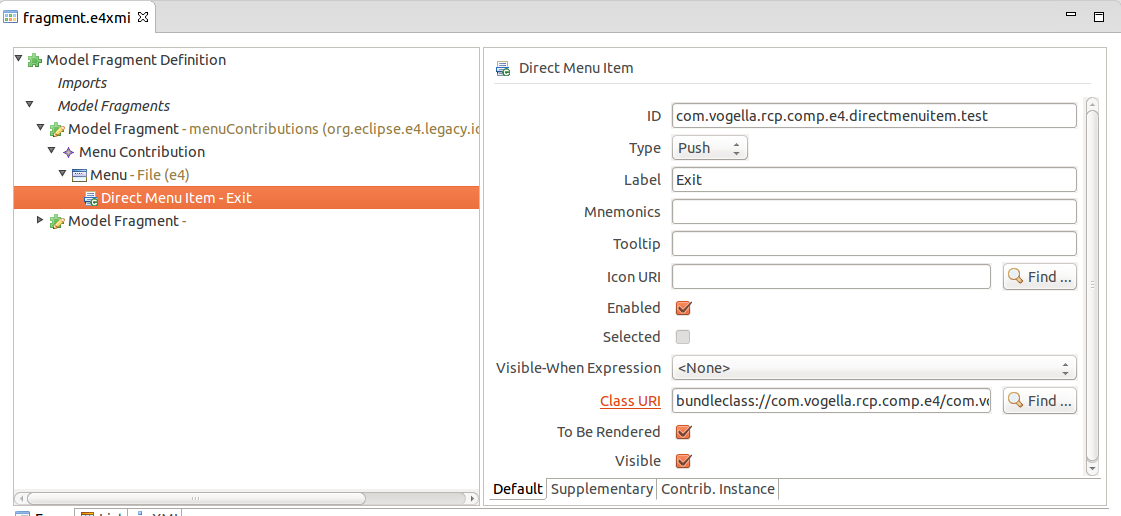
After you added a MenuContribution item you can contribute a menu. The Parent-ID must be the ID of the menu your are contributing to.
The model fragment must be registered in the plugin.xml file via an extension to the org.eclipse.e4.workbench.model extension point, as demonstrated in the following listing.
<?xml version="1.0" encoding="utf-8"?> <plugin> <extension id= "id1" point= "org.eclipse.e4.workbench.model" > <fragment apply= "notexists" uri= "fragment.e4xmi" > </fragment> </extension> </plugin> 8.3. Error analysis
In case of problems, check the source code of plugin.xml and validate that your model fragment is included. Verify the name of the referred model fragment and ensure all the defined ID are available in the running configuration.
8.4. Adding e4 toolbar entries to the appliation window
Similar to menus you can contribute toolbar contributions.
| This approach does currently not work for view toolbars. |
8.5. Supporting part descriptors in an Eclipse IDE
The Eclipse IDE supports the contribution of part descriptor model elements via fragments or processors.
If you use the org.eclipse.e4.legacy.ide.application ID to contribute your part descriptors, the views can be opened via the dialog or via the Quick Access. This requires that you add the View tag to such a part descriptor.
| Eclipse 3.x API RCP applications running on top of a 4.5 or higher runtime can use the same approach. |
8.6. Adding perspectives to the Eclipse IDE via model snippets
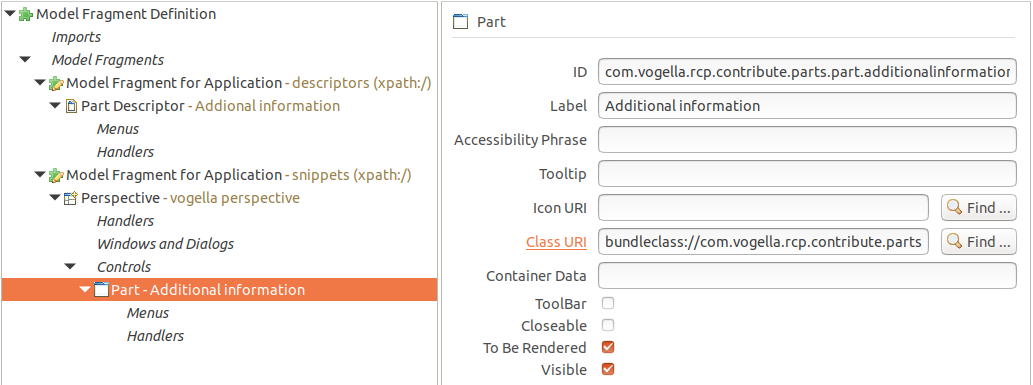
Your model fragment or processor can also contribute a perspective to an Eclipse 4.x IDE. For this add a perspective via a snippet. This extended element id can be generic with xpath:/ and the Feature name is snippets.
This approach can also be used to contribute a perspective to your Eclipse 3.x API based RCP application running on top of an Eclipse 4.x runtime.
9. Exercise: Add a new perspective to the Eclipse IDE
In this exercise you contribute a new perspective to the Eclipse IDE.
9.1. Create model elements
In your com.vogella.contribute.parts plug-in, create the following model fragment.

Add at least one part to the perspective.
9.2. Validate
Start the Eclipse IDE and validate that you can open the new perspective via the perspective switcher dialog.
10. Optional Exercise: Adding POJO views via extension points
In this exercise you create a e4 based view extension via a separate plug-in. For this you use e4view element of the org.eclipse.ui.views extension point.
This extension can be contributed to the Eclipse IDE (or another Eclipse 3.x API based RCP application).
10.1. Create a plug-in
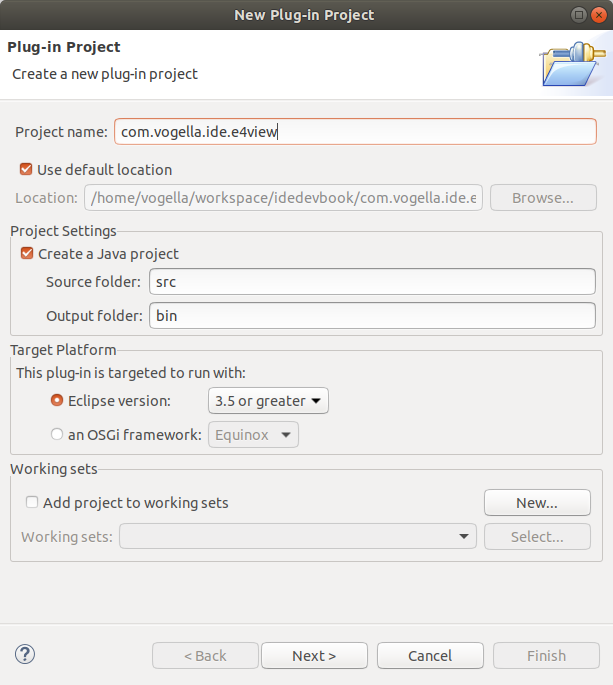
Create an plug-in called com.vogella.ide.e4view. Use the .
Call the project com.vogella.ide.e4view and select the options similar to the following screenshots.
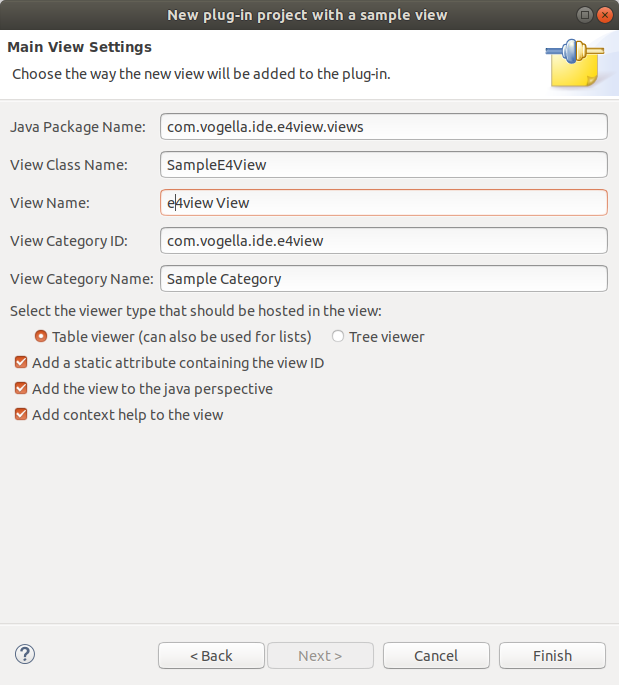
10.2. Adjust Plug-in dependencies
Add org.eclipse.e4.ui.di as a dependency to the manifest of your new plug-in.
10.3. Create your e4 view
Adjust the created implementation of SampleE4View to the following.
package com.vogella.ide.e4view.views ; import javax.annotation.PostConstruct ; import javax.inject.Inject ; import org.eclipse.e4.ui.di.Focus ; import org.eclipse.jface.action.Action ; import org.eclipse.jface.action.IMenuListener ; import org.eclipse.jface.action.IMenuManager ; import org.eclipse.jface.action.MenuManager ; import org.eclipse.jface.action.Separator ; import org.eclipse.jface.dialogs.MessageDialog ; import org.eclipse.jface.viewers.ArrayContentProvider ; import org.eclipse.jface.viewers.DoubleClickEvent ; import org.eclipse.jface.viewers.IDoubleClickListener ; import org.eclipse.jface.viewers.IStructuredSelection ; import org.eclipse.jface.viewers.ITableLabelProvider ; import org.eclipse.jface.viewers.LabelProvider ; import org.eclipse.jface.viewers.TableViewer ; import org.eclipse.swt.SWT ; import org.eclipse.swt.graphics.Image ; import org.eclipse.swt.widgets.Composite ; import org.eclipse.swt.widgets.Menu ; import org.eclipse.ui.ISharedImages ; import org.eclipse.ui.IWorkbench ; import org.eclipse.ui.IWorkbenchActionConstants ; public class SampleE4View { /** * The ID of the view as specified by the extension. */ public static final String ID = "com.vogella.ide.e4view.views.SampleE4View" ; @Inject IWorkbench workbench ; private TableViewer viewer ; private Action action1 ; private Action action2 ; private Action doubleClickAction ; class ViewLabelProvider extends LabelProvider implements ITableLabelProvider { @Override public String getColumnText ( Object obj , int index ) { return getText ( obj ); } @Override public Image getColumnImage ( Object obj , int index ) { return getImage ( obj ); } @Override public Image getImage ( Object obj ) { return workbench . getSharedImages (). getImage ( ISharedImages . IMG_OBJ_ELEMENT ); } } @PostConstruct public void createPartControl ( Composite parent ) { viewer = new TableViewer ( parent , SWT . MULTI | SWT . H_SCROLL | SWT . V_SCROLL ); viewer . setContentProvider ( ArrayContentProvider . getInstance ()); viewer . setInput ( new String [] { "One" , "Two" , "Three" }); viewer . setLabelProvider ( new ViewLabelProvider ()); // Create the help context id for the viewer's control workbench . getHelpSystem (). setHelp ( viewer . getControl (), "com.vogella.ide.e4view.viewer" ); makeActions (); hookContextMenu (); hookDoubleClickAction (); } private void hookContextMenu () { MenuManager menuMgr = new MenuManager ( "#PopupMenu" ); menuMgr . setRemoveAllWhenShown ( true ); menuMgr . addMenuListener ( new IMenuListener () { @Override public void menuAboutToShow ( IMenuManager manager ) { SampleE4View . this . fillContextMenu ( manager ); } }); Menu menu = menuMgr . createContextMenu ( viewer . getControl ()); viewer . getControl (). setMenu ( menu ); } private void fillContextMenu ( IMenuManager manager ) { manager . add ( action1 ); manager . add ( action2 ); // Other plug-ins can contribute there actions here manager . add ( new Separator ( IWorkbenchActionConstants . MB_ADDITIONS )); } private void makeActions () { action1 = new Action () { @Override public void run () { showMessage ( "Action 1 executed" ); } }; action1 . setText ( "Action 1" ); action1 . setToolTipText ( "Action 1 tooltip" ); action1 . setImageDescriptor ( workbench . getSharedImages (). getImageDescriptor ( ISharedImages . IMG_OBJS_INFO_TSK )); action2 = new Action () { @Override public void run () { showMessage ( "Action 2 executed" ); } }; action2 . setText ( "Action 2" ); action2 . setToolTipText ( "Action 2 tooltip" ); action2 . setImageDescriptor ( workbench . getSharedImages (). getImageDescriptor ( ISharedImages . IMG_OBJS_INFO_TSK )); doubleClickAction = new Action () { @Override public void run () { IStructuredSelection selection = viewer . getStructuredSelection (); Object obj = selection . getFirstElement (); showMessage ( "Double-click detected on " + obj . toString ()); } }; } private void hookDoubleClickAction () { viewer . addDoubleClickListener ( new IDoubleClickListener () { @Override public void doubleClick ( DoubleClickEvent event ) { doubleClickAction . run (); } }); } private void showMessage ( String message ) { MessageDialog . openInformation ( viewer . getControl (). getShell (), "e4view View" , message ); } @Focus public void setFocus () { viewer . getControl (). setFocus (); } } | If you now start this plug-in and open your view , you receive the |
10.4. Adjust the entries in the extension point
Replace the view attribute with an e4view attribute for the org.eclipse.ui.views extension point.
For this use the Extensions tab of the plugin.xml editor.
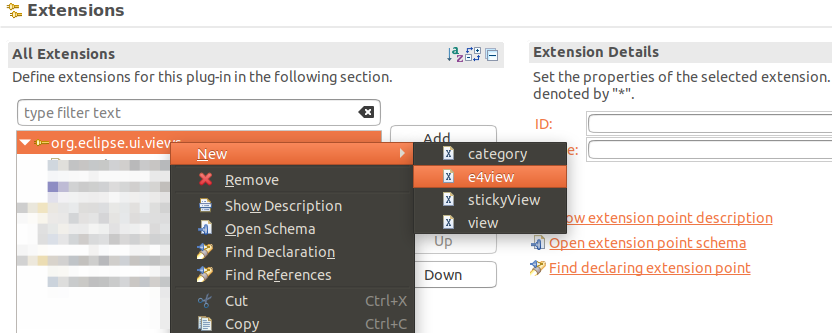
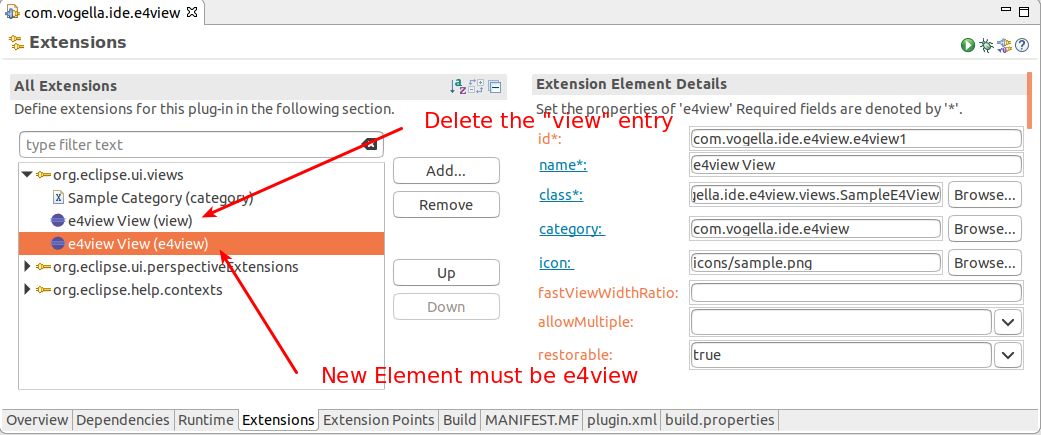
The final relevant source code for the org.eclipse.ui.views extension in the plugin.xml file should look similar to the following:
<?xml version="1.0" encoding="UTF-8"?> <?eclipse version="3.4"?> <plugin> <extension point= "org.eclipse.ui.views" > <category name= "Sample Category" id= "com.vogella.ide.e4view" > </category> <e4view category= "com.vogella.ide.e4view" class= "com.vogella.ide.e4view.views.SampleE4View" icon= "icons/sample.png" id= "com.vogella.ide.e4view.e4view1" name= "e4view View" restorable= "true" > </e4view> </extension> <!-- MORE ENTRIES, LEFT OUT FOR BREVITY --> </plugin> 10.5. Validate the usage of the e4 view
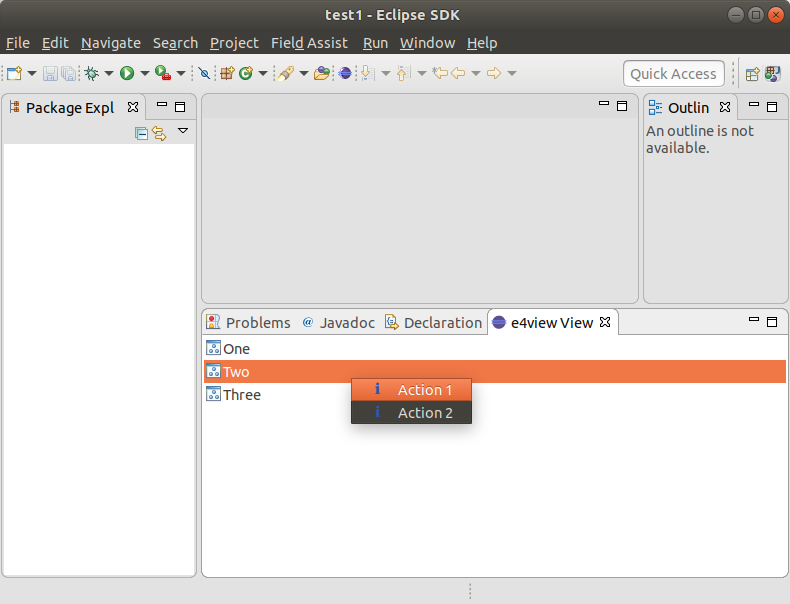
Start your plug-in in the Eclipse IDE and validate that you can open the view via the menu entry. The view should look similar to the following and should provide a context menu on the items.
| To avoid seeing model persisted data, add the |
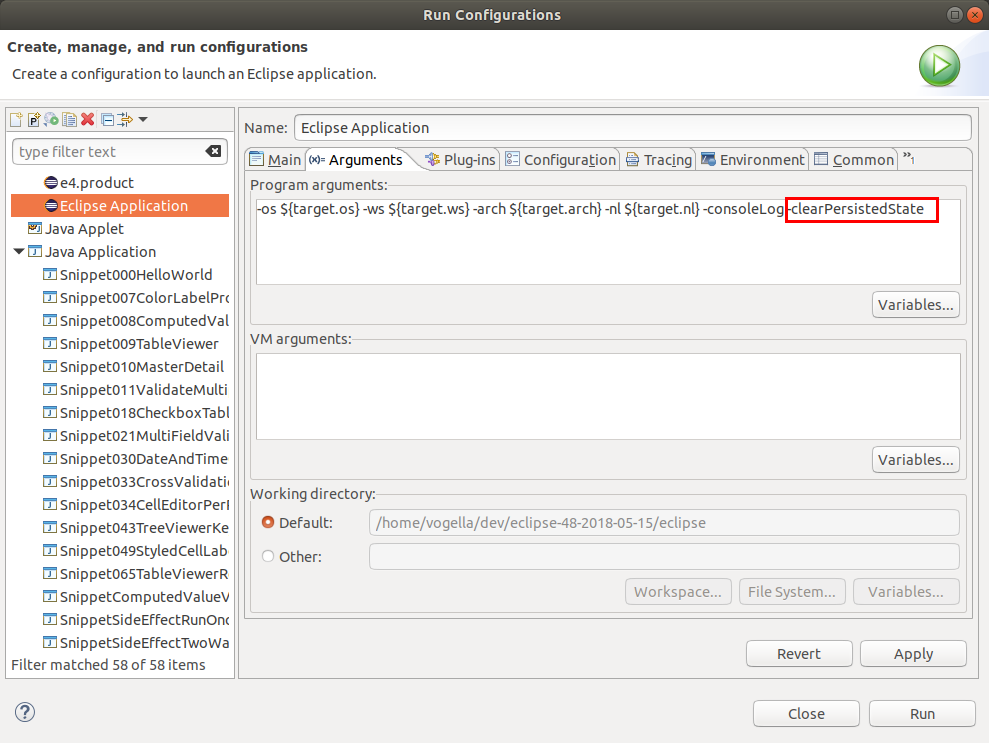
10.6. Add the view to a perspective extension
To add the view to the Java perspective, adjust the existing org.eclipse.ui.perspectiveExtensions entry as depicted in the following screenshot.
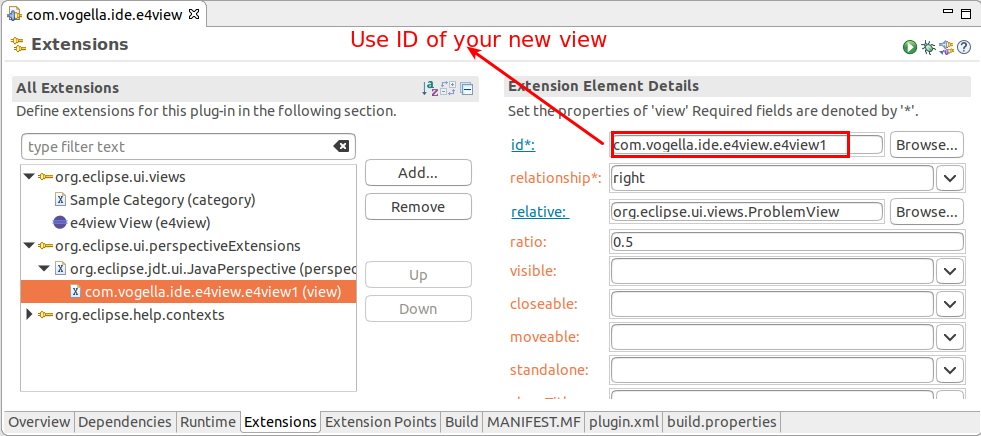
10.7. Optional exercise: Add a toolbar to your e4 view
The extension point processing currently expects the normal view extension not the e4view extension. To add a toolbar to your e4view you have to process the relevant information yourself. For example, you could get the EModelService injected and add the toolbar based on the extension registry or a model snippet. The following simply creates one toolbar entry for demonstration purposes.
@PostConstruct public void createPartControl ( Composite parent , MPart part , EModelService modelService ) { viewer = new TableViewer ( parent , SWT . MULTI | SWT . H_SCROLL | SWT . V_SCROLL ); viewer . setUseHashlookup ( true ); // use faster hash lookup of data model viewer . setContentProvider ( ArrayContentProvider . getInstance ()); viewer . setInput ( new String [] { "One" , "Two" , "Three" }); viewer . setLabelProvider ( new ViewLabelProvider ()); // Create the help context id for the viewer's control workbench . getHelpSystem (). setHelp ( viewer . getControl (), "com.vogella.ide.e4view.viewer" ); makeActions (); hookContextMenu (); hookDoubleClickAction (); MToolBar toolbar = modelService . createModelElement ( MToolBar . class ); MHandledToolItem toolitem = modelService . createModelElement ( MHandledToolItem . class ); toolitem . setLabel ( "View Tool Item" ); // TODO set the icon and the command relevant for the toolbar item toolbar . getChildren (). add ( toolitem ); part . setToolbar ( toolbar ); } In this exercise you will add menu and toolbar contributions to the IDE via the com.vogella.tasks.ui plug-in.
11.1. Adding the plug-in dependencies
Ensure that the following dependencies are in the manifest file of com.vogella.tasks.ui.
-
org.eclipse.e4.core.di, -
org.eclipse.jface
11.2. Creating the handler class
Create the following class based on the generated handler class.
package com.vogella.tasks.ui.handlers ; import org.eclipse.e4.core.di.annotations.Execute ; import org.eclipse.jface.dialogs.MessageDialog ; import org.eclipse.swt.widgets.Shell ; public class TestHandler { @Execute public void execute ( Shell shell ) { MessageDialog . openInformation ( shell , "First" , "Hello, e4 API world" ); } } 11.3. Create a model fragment for your contributions
Create a new model fragment via from the context menu of the plug-in project.
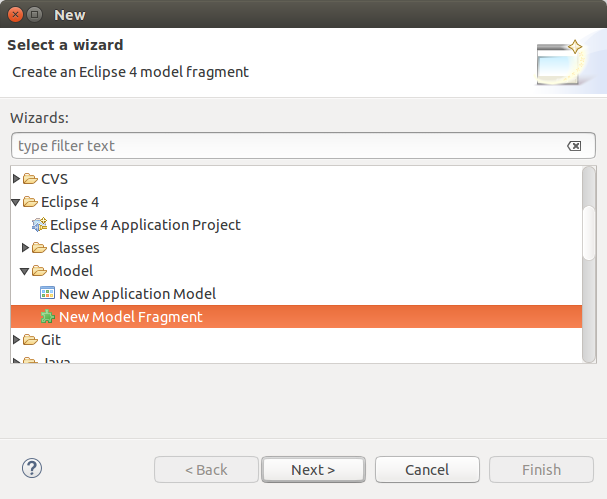
The file should be called commands.e4xmi.
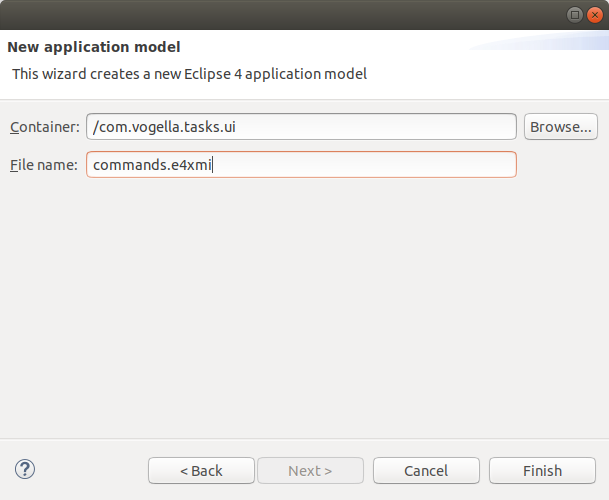
Press the Finish button.
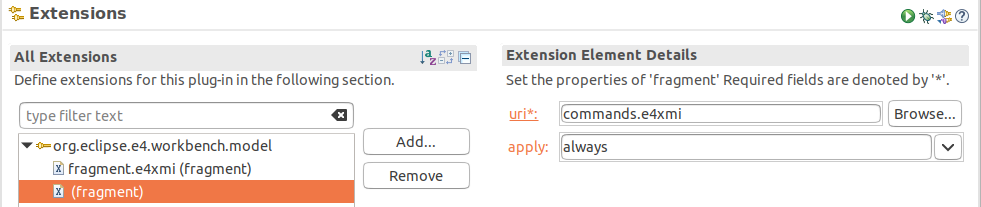
Ensure that the new fragment is correctly registered in the plugin.xml as extension.
11.4. Define a command contribution
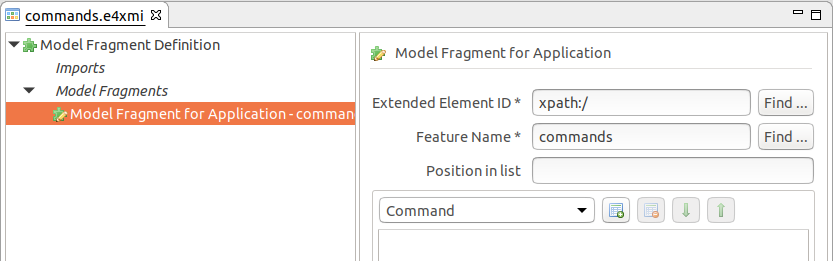
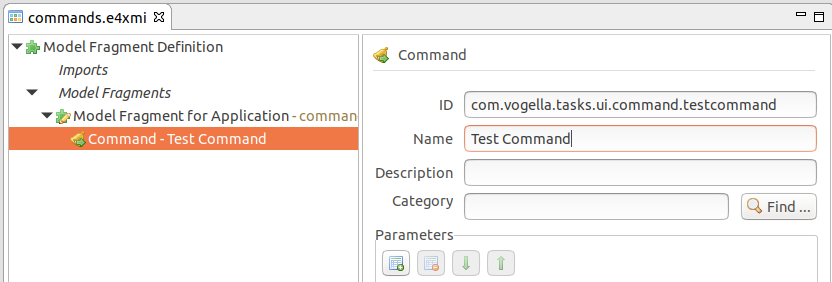
Create a model fragment contributing a command to the commands of the top-level element using the xpath:/ element id.
Use the following screenshots to define the new contribution.
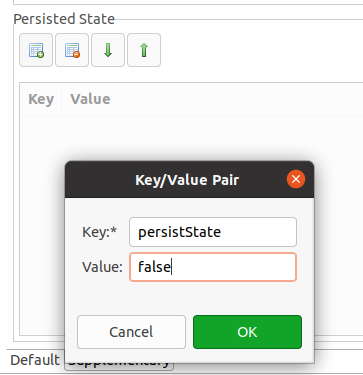
Ensure to set the persistState flag to false. This ensures that the element is not available if the plug-in is not installed.
11.5. Define a handler contribution
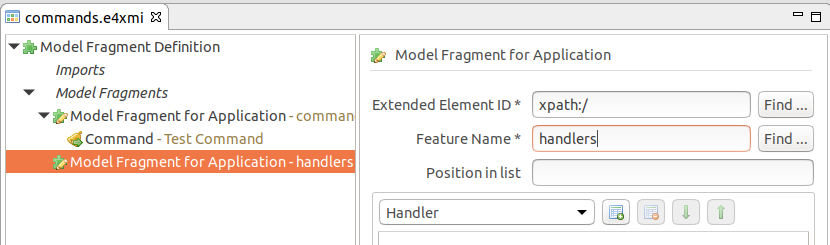
Add a handler for the defined command and use your TestHandler as implementation.

Ensure to set the persistState flag to false. This ensures that the element is not available if the plug-in is not installed.
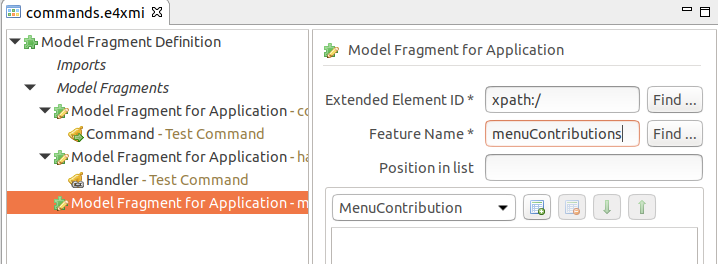
Ensure to set the persistState flag to false. This ensures that the element is not available if the plug-in is not installed.
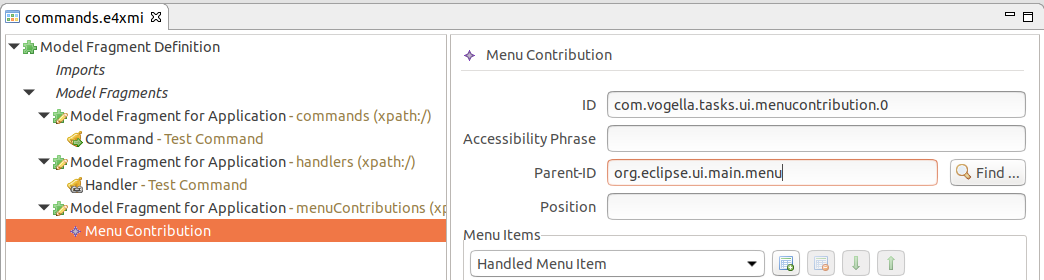
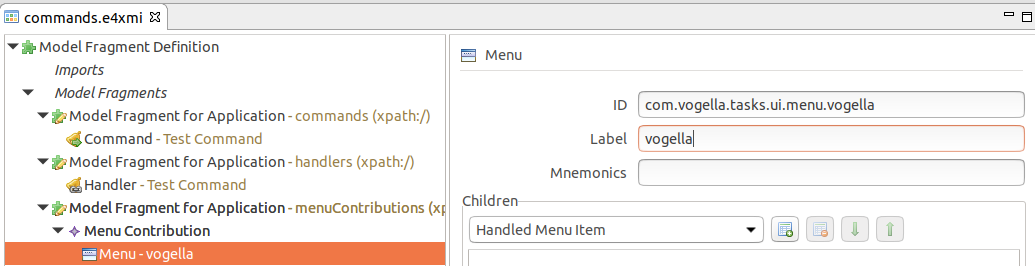
Add at least one menu entry to your menu, otherwise it will not be displayed.
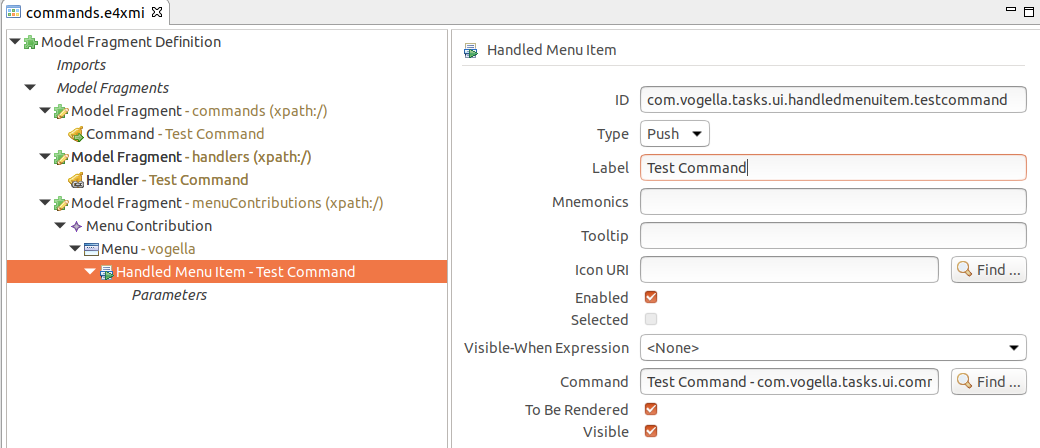
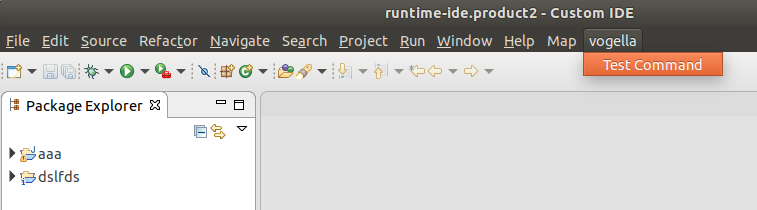
Start a new instance of the Eclipse IDE and validate that your menu is visible and working. If it is not visible, check via the model spy for potential issues.
12. Exercise: Add a trimbar to the Eclipse IDE
12.1. Adding a trimbar contribution
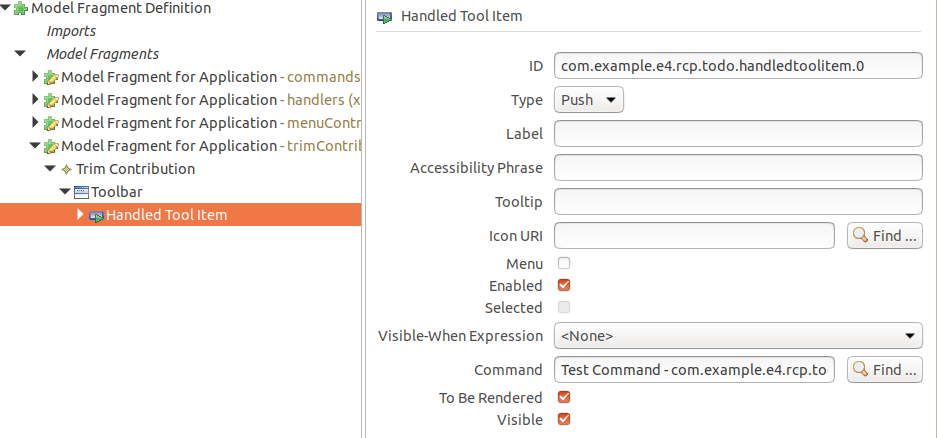
Also add a trimbar contribution for the same command.

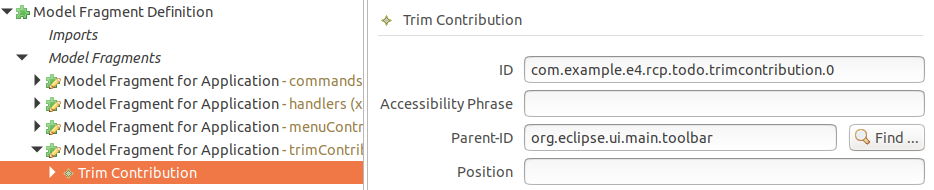
Ensure to set the persistState flag to false. This ensures that the element is not available if the plug-in is not installed.
Add a toolbar to your trimbar.
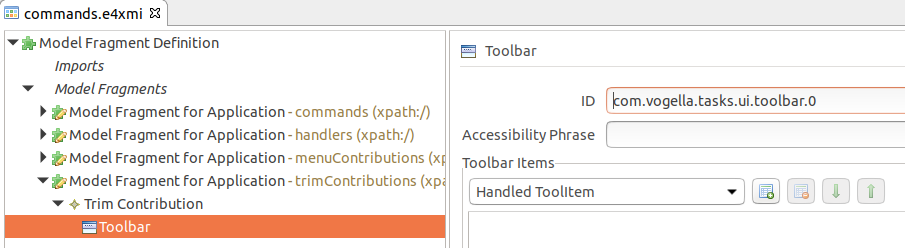
Add a handled tool item to your contribution.
12.2. Validate the presence of the toolbar contribution
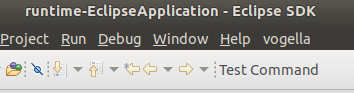
Start a new instance of the Eclipse IDE and validate that your new toolbar is available. If they are not visible in the window, check via the model spy for potential issues.
13. Optional Exercise: Add icon to your toolbar entry
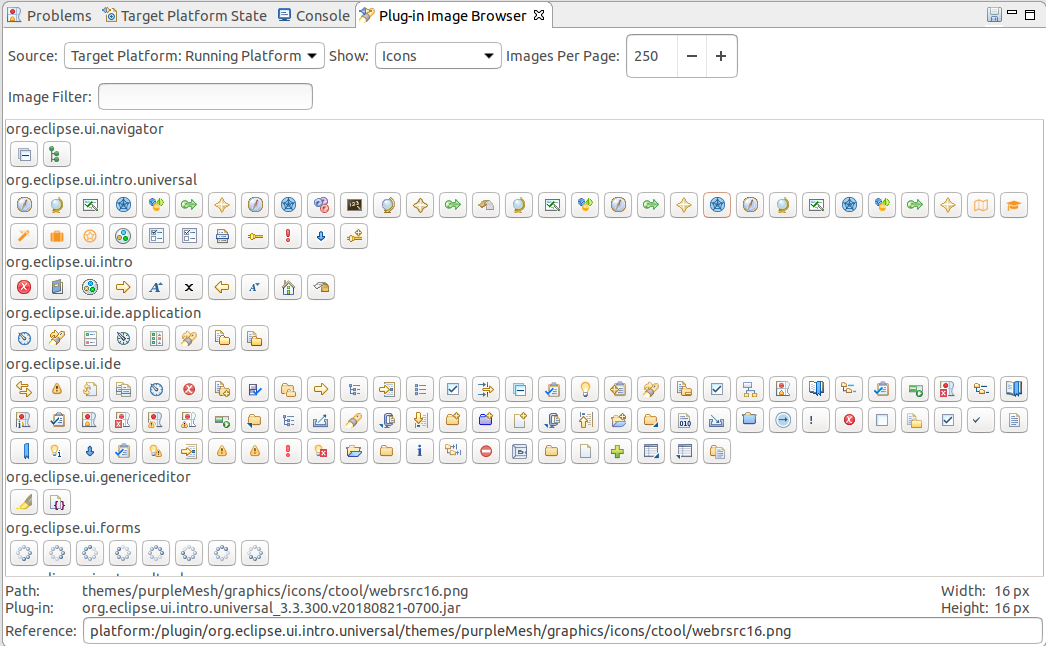
Create an icons folder. Use the Plug-in Image Browser to save an icon in your project.
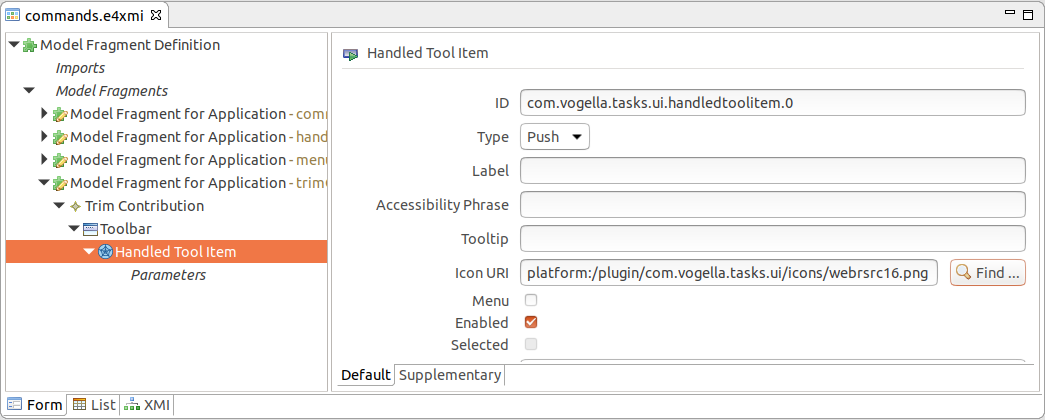
Assign this icon to your toolbar entry.
14. Resources and Marker
Eclipse represents Resources like Projects, Files, Folders, Packages as IResource.
Marker represent additional information for resources, e.g., an error marker. This information is not stored within the resource (file) but as additional information in the workspace metadata.
Every marker can have attributes (key / value combination). Markers can be displayed in the standard view, e.g., the Task, Bookmark or the Problems view. To be displayed in these views, you have to use predefined attributes.
15. Exercise: Create Markers for resources
Create a plug-in project com.vogella.plugin.markers based on the e4 handler template.
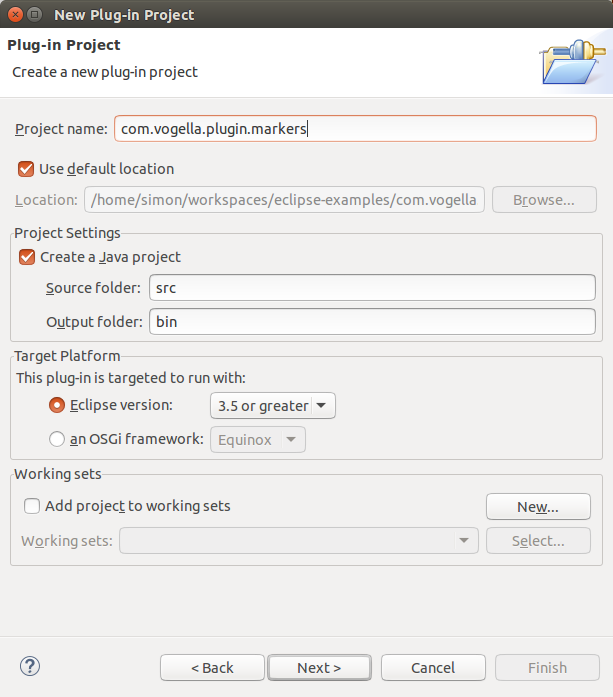
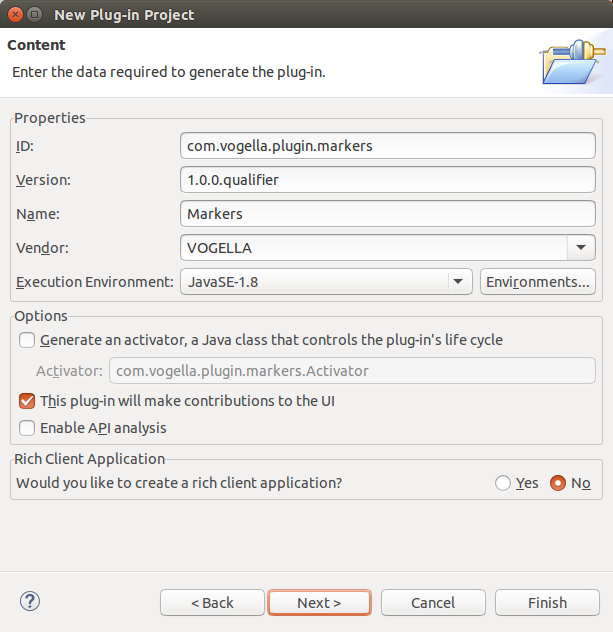
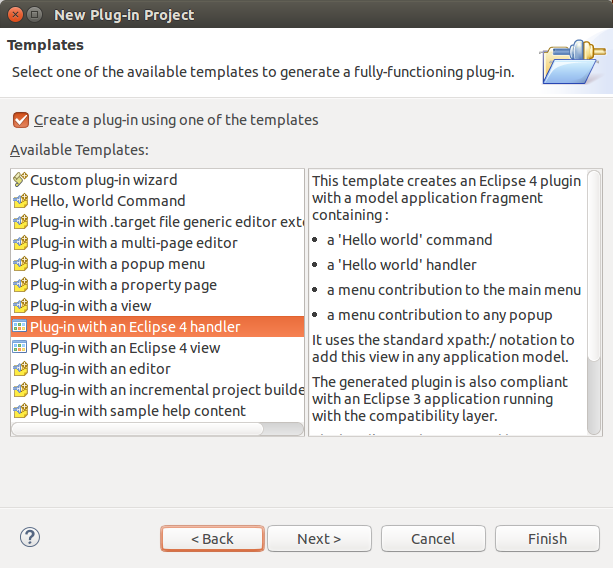
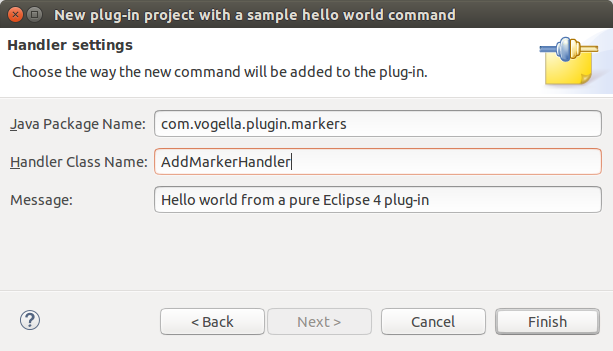
This template will create a AddMarkerHandler handler, which should be used to create an IMarker for a selected resource.
Add the following dependencies:
-
org.eclipse.jface
-
org.eclipse.e4.ui.services
-
org.eclipse.e4.core.di.annotations
-
org.eclipse.core.resources
-
org.eclipse.core.runtime
-
org.eclipse.e4.core.services
Modify the AddMarkerHandler code to the following:
package de.vogella.plugin.markers.handler ; import javax.inject.Named ; import org.eclipse.core.resources.IMarker ; import org.eclipse.core.resources.IResource ; import org.eclipse.e4.core.di.annotations.Execute ; import org.eclipse.e4.core.services.adapter.Adapter ; import org.eclipse.e4.ui.services.IServiceConstants ; import org.eclipse.jface.viewers.IStructuredSelection ; public class AddMarkerHandler { @Execute public void execute ( @Named ( IServiceConstants . ACTIVE_SELECTION ) IStructuredSelection selection , Adapter adapter ) { if ( selection == null || selection . isEmpty ()) { return ; } Object firstElement = selection . getFirstElement (); IResource resource = adapter . adapt ( firstElement , IResource . class ); if ( resource != null ) { writeMarkers ( resource ); } } private void writeMarkers ( IResource resource ) { try { IMarker marker = resource . createMarker ( IMarker . TASK ); marker . setAttribute ( IMarker . MESSAGE , "This is a task" ); marker . setAttribute ( IMarker . PRIORITY , IMarker . PRIORITY_HIGH ); } catch ( Exception e ) { e . printStackTrace (); } } } In the fragment.e4xmi file the command's name should be changed from "Hello World" to "Add Task Marker".
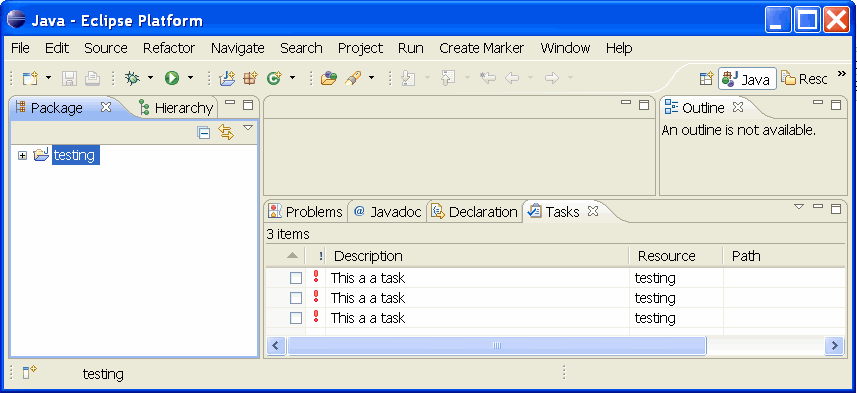
If you run, you can create a marker in the Tasks View if you select a Java project or any other IResource and click the menu entry.
16. Adapters
Adapters help to display information about objects in view without having to adjust the existing views.
17. Exercise - Adapters for the Properties view
We will simply use an adapter to show our data in the Properties view.
Create a new plug-in project de.vogella.plugin.adapter.
Add the following dependencies in the dependencies tab of the MANIFEST.MF file:
-
org.eclipse.core.runtime
-
org.eclipse.e4.ui.model.workbench
-
org.eclipse.e4.ui.services
-
org.eclipse.e4.ui.workbench
-
org.eclipse.ui
-
org.eclipse.ui.views
Create the following Todo class as data model.
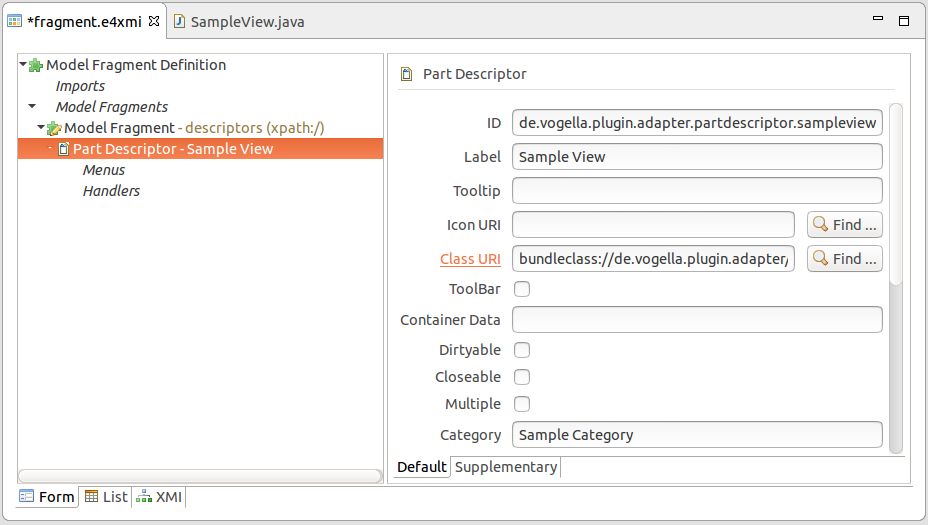
package de.vogella.plugin.adapter.model ; public class Todo { private String summary ; private String description ; private boolean done ; public String getSummary () { return summary ; } public void setSummary ( String summary ) { this . summary = summary ; } public String getDescription () { return description ; } public void setDescription ( String description ) { this . description = description ; } public boolean isDone () { return done ; } public void setDone ( boolean done ) { this . done = done ; } } Create a model fragment (fragment.e4xmi) and add a PartDescriptor called Sample View.
Create SampleView.java as part for the PartDescriptor implementation.
package de.vogella.plugin.adapter.views ; import java.util.ArrayList ; import java.util.List ; import javax.annotation.PostConstruct ; import org.eclipse.e4.ui.workbench.modeling.ESelectionService ; import org.eclipse.jface.viewers.ArrayContentProvider ; import org.eclipse.jface.viewers.ISelectionChangedListener ; import org.eclipse.jface.viewers.ITableLabelProvider ; import org.eclipse.jface.viewers.LabelProvider ; import org.eclipse.jface.viewers.SelectionChangedEvent ; import org.eclipse.jface.viewers.TableViewer ; import org.eclipse.swt.SWT ; import org.eclipse.swt.graphics.Image ; import org.eclipse.swt.widgets.Composite ; import org.eclipse.ui.ISharedImages ; import org.eclipse.ui.PlatformUI ; import de.vogella.plugin.adapter.model.Todo ; public class SampleView { private TableViewer viewer ; class ViewLabelProvider extends LabelProvider implements ITableLabelProvider { public String getColumnText ( Object obj , int index ) { Todo todo = ( Todo ) obj ; return todo . getSummary (); } public Image getColumnImage ( Object obj , int index ) { return getImage ( obj ); } public Image getImage ( Object obj ) { return PlatformUI . getWorkbench (). getSharedImages (). getImage ( ISharedImages . IMG_OBJ_ELEMENT ); } } /** * This is a callback that will allow us to create the viewer and initialize * it. */ @PostConstruct public void createPartControl ( Composite parent , ESelectionService selectionService ) { viewer = new TableViewer ( parent , SWT . MULTI | SWT . H_SCROLL | SWT . V_SCROLL ); viewer . setContentProvider ( new ArrayContentProvider ()); viewer . setLabelProvider ( new ViewLabelProvider ()); viewer . addSelectionChangedListener ( new ISelectionChangedListener () { @Override public void selectionChanged ( SelectionChangedEvent event ) { selectionService . setSelection ( event . getSelection ()); } }); viewer . setInput ( getElements ()); } // Build up a simple data model private List < Todo > getElements () { List < Todo > todos = new ArrayList <>(); Todo todo = new Todo (); todo . setSummary ( "First Todo" ); todo . setDescription ( "A very good description" ); todo . setDone ( true ); todos . add ( todo ); todo = new Todo (); todo . setSummary ( "Second Todo" ); todo . setDescription ( "Second super description" ); todos . add ( todo ); return todos ; } } After this change, you should be able to run your project, open your view and see your to-do items.
To display the Todo values in the Properties view, add the extension point org.eclipse.core.runtime.adapters to your project.
The data of the extension point should be like the following:
<extension point= "org.eclipse.core.runtime.adapters" > <factory adaptableType= "de.vogella.plugin.adapter.model.Todo" class= "de.vogella.plugin.adapter.TodoAdapterFactory" > <adapter type= "org.eclipse.ui.views.properties.IPropertySource" > </adapter> </factory> </extension> Implement the IPropertySource interface to provide it for the Properties view.
package de.vogella.plugin.adapter ; import org.eclipse.ui.views.properties.IPropertyDescriptor ; import org.eclipse.ui.views.properties.IPropertySource ; import org.eclipse.ui.views.properties.TextPropertyDescriptor ; import de.vogella.plugin.adapter.model.Todo ; public class TodoPropertySource implements IPropertySource { private final Todo todo ; public TodoPropertySource ( Todo todo ) { this . todo = todo ; } @Override public boolean isPropertySet ( Object id ) { return false ; } @Override public Object getEditableValue () { return this ; } @Override public IPropertyDescriptor [] getPropertyDescriptors () { return new IPropertyDescriptor [] { new TextPropertyDescriptor ( "summary" , "Summary" ), new TextPropertyDescriptor ( "description" , "Description" ) }; } @Override public Object getPropertyValue ( Object id ) { if ( id . equals ( "summary" )) { return todo . getSummary (); } if ( id . equals ( "description" )) { return todo . getDescription (); } return null ; } @Override public void resetPropertyValue ( Object id ) { } @Override public void setPropertyValue ( Object id , Object value ) { String s = ( String ) value ; if ( id . equals ( "summary" )) { todo . setSummary ( s ); } if ( id . equals ( "description" )) { todo . setDescription ( s ); } } } Implement the factory and the new class TodoPropertySource which implements IPropertySource.
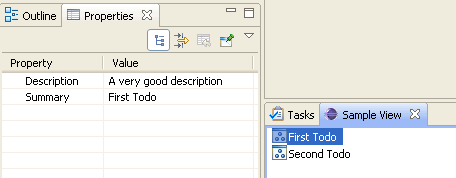
package de.vogella.plugin.adapter ; import org.eclipse.core.runtime.IAdapterFactory ; import org.eclipse.ui.views.properties.IPropertySource ; import de.vogella.plugin.adapter.model.Todo ; public class TodoAdapterFactory implements IAdapterFactory { // use a static final field so that the adapterList is only instanciated once private static final Class <?>[] adapterList = new Class <?>[] { IPropertySource . class }; @Override public < T > T getAdapter ( Object adaptableObject , Class < T > adapterType ) { if ( adapterType == IPropertySource . class && adaptableObject instanceof Todo ){ return adapterType . cast ( new TodoPropertySource (( Todo ) adaptableObject )); } return null ; } @Override public Class <?>[] getAdapterList () { return adapterList ; } } If you run your workbench and open your view via and you select a data element in your viewer you should see your data in the Properties view.
18. Exercise - Adapters and the WorkbenchLabelProvider
The de.vogella.plugin.adapter plug-in from the Exercise - Adapters for the Properties view should be reused for this exercise.
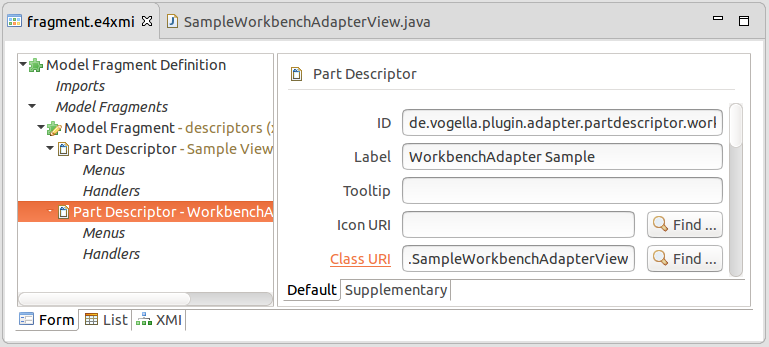
Create another PartDescriptor called WorkbenchAdapter Sample, which also has the Sample Category category.
Create SampleWorkbenchAdapterView.java as part for the PartDescriptor implementation. The only difference to the previous SampleView is that a DelegatingStyledCellLabelProvider is used as LabelProvider, which takes the WorkbenchLabelProvider as IStyledLabelProvider implementation.
package de.vogella.plugin.adapter.views ; import java.util.ArrayList ; import java.util.List ; import javax.annotation.PostConstruct ; import org.eclipse.e4.ui.workbench.modeling.ESelectionService ; import org.eclipse.jface.viewers.ArrayContentProvider ; import org.eclipse.jface.viewers.DelegatingStyledCellLabelProvider ; import org.eclipse.jface.viewers.ISelectionChangedListener ; import org.eclipse.jface.viewers.SelectionChangedEvent ; import org.eclipse.jface.viewers.TableViewer ; import org.eclipse.swt.SWT ; import org.eclipse.swt.widgets.Composite ; import org.eclipse.ui.model.WorkbenchLabelProvider ; import de.vogella.plugin.adapter.model.Todo ; public class SampleWorkbenchAdapterView { private TableViewer viewer ; /** * This is a callback that will allow us to create the viewer and initialize * it. */ @PostConstruct public void createPartControl ( Composite parent , ESelectionService selectionService ) { viewer = new TableViewer ( parent , SWT . MULTI | SWT . H_SCROLL | SWT . V_SCROLL ); viewer . setContentProvider ( new ArrayContentProvider ()); // make use of the DelegatingStyledCellLabelProvider with the WorkbenchLabelProvider as IStyledLabelProvider implementation viewer . setLabelProvider ( new DelegatingStyledCellLabelProvider ( new WorkbenchLabelProvider ())); viewer . addSelectionChangedListener ( new ISelectionChangedListener () { @Override public void selectionChanged ( SelectionChangedEvent event ) { selectionService . setSelection ( event . getSelection ()); } }); viewer . setInput ( getElements ()); } // Build up a simple data model private List < Todo > getElements () { List < Todo > todos = new ArrayList <>(); Todo todo = new Todo (); todo . setSummary ( "First Todo" ); todo . setDescription ( "A very good description" ); todo . setDone ( true ); todos . add ( todo ); todo = new Todo (); todo . setSummary ( "Second Todo" ); todo . setDescription ( "Second super description" ); todos . add ( todo ); return todos ; } } When using a WorkbenchLabelProvider the objects, which are supposed to be shown in the Viewer should provide an adapter for the IWorkbenchAdapter, IWorkbenchAdapter2 and IWorkbenchAdapter3 interface, but at least for the the IWorkbenchAdapter. These interfaces can be used by the WorkbenchLabelProvider in order to determine how the objects should be visualized.
To provide these adapters for the WorkbenchLabelProvider a TodoWorkbenchAdapter is created. It derives from WorkbenchAdapter, which is an abstract class that implements all three interfaces.
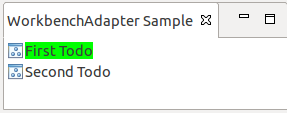
package de.vogella.plugin.adapter ; import org.eclipse.jface.resource.ImageDescriptor ; import org.eclipse.jface.viewers.StyledString ; import org.eclipse.jface.viewers.StyledString.Styler ; import org.eclipse.swt.SWT ; import org.eclipse.swt.graphics.TextStyle ; import org.eclipse.swt.widgets.Display ; import org.eclipse.ui.ISharedImages ; import org.eclipse.ui.PlatformUI ; import org.eclipse.ui.model.WorkbenchAdapter ; import de.vogella.plugin.adapter.model.Todo ; public class TodoWorkbenchAdapter extends WorkbenchAdapter { @Override public ImageDescriptor getImageDescriptor ( Object object ) { return PlatformUI . getWorkbench (). getSharedImages (). getImageDescriptor ( ISharedImages . IMG_OBJ_ELEMENT ); } @Override public StyledString getStyledText ( Object object ) { if ( object instanceof Todo ) { Todo todo = ( Todo ) object ; StyledString styledString = new StyledString ( todo . getSummary ()); if ( todo . isDone ()) { Styler styler = new Styler () { @Override public void applyStyles ( TextStyle textStyle ) { // Todos, which are done should have a green background textStyle . background = Display . getCurrent (). getSystemColor ( SWT . COLOR_GREEN ); } }; styledString . setStyle ( 0 , todo . getSummary (). length (), styler ); } return styledString ; } return super . getStyledText ( object ); } } Now the TodoAdapterFactory has to be extended to also provide the TodoWorkbenchAdapter.
package de.vogella.plugin.adapter ; import org.eclipse.core.runtime.IAdapterFactory ; import org.eclipse.ui.model.WorkbenchAdapter ; import org.eclipse.ui.views.properties.IPropertySource ; import de.vogella.plugin.adapter.model.Todo ; public class TodoAdapterFactory implements IAdapterFactory { // use a static final field so that the adapterList is only instanciated once private static final Class <?>[] adapterList = new Class <?>[] { IPropertySource . class , WorkbenchAdapter . class }; @Override public < T > T getAdapter ( Object adaptableObject , Class < T > adapterType ) { if ( adapterType == IPropertySource . class && adaptableObject instanceof Todo ){ return adapterType . cast ( new TodoPropertySource (( Todo ) adaptableObject )); } else if ( adapterType . isAssignableFrom ( WorkbenchAdapter . class ) && adaptableObject instanceof Todo ) { return adapterType . cast ( new TodoWorkbenchAdapter ()); } return null ; } @Override public Class <?>[] getAdapterList () { return adapterList ; } } Now that the TodoAdapterFactory can also return WorkbenchAdapter objects, it also has to be specified in the org.eclipse.core.runtime.adapters extension point.
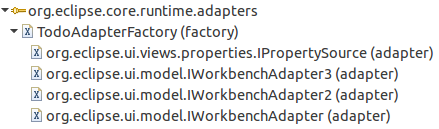
The result should look similar this:
19. Eclipse Resources
You can register IResourceChangeListener on resources in Eclipse. For example, if you have a project, you can add or remove a resource listener to or from it.
// add listener project . getWorkspace (). addResourceChangeListener ( listener ); // Remove listener project . getWorkspace (). removeResourceChangeListener ( listener ); // Example resource listener private IResourceChangeListener listener = new IResourceChangeListener () { public void resourceChanged ( IResourceChangeEvent event ) { if ( event . getType () == IResourceChangeEvent . PRE_CLOSE || event . getType () == IResourceChangeEvent . PRE_DELETE ) { if ( event . getResource (). equals ( project )) { // Project deleted or closed // do something } return ; } if ( resource == null ) return ; IResourceDelta delta = event . getDelta (). findMember ( new Path ( resource . getURI (). toPlatformString ( false ))); if ( delta == null ) { return ; } if ( delta . getKind () == IResourceDelta . REMOVED ) { // Resource delete // do something } } }; 20. Exercise: Create a feature for your plug-in
20.1. Create a feature project
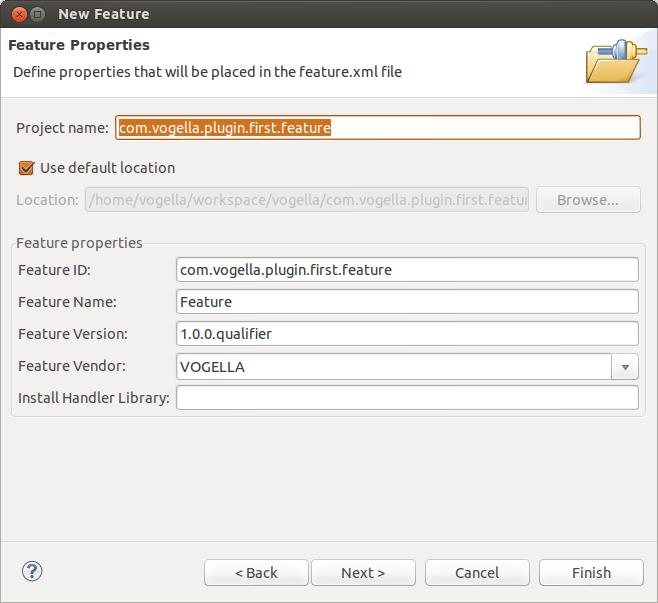
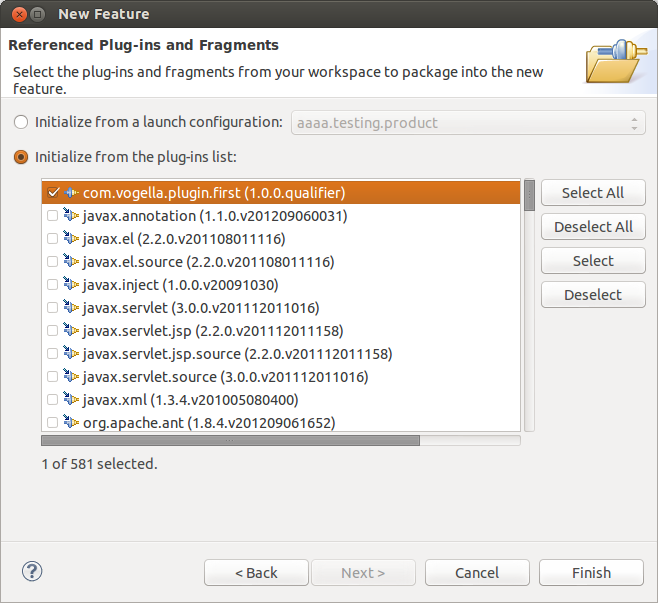
Create a feature project for your plug-in and add your plug-in to this feature. You create a feature project via .
Create the feature project according to the following screenshots.
20.2. Create a category definition
In your feature project create a new category definition, via the menu entry .
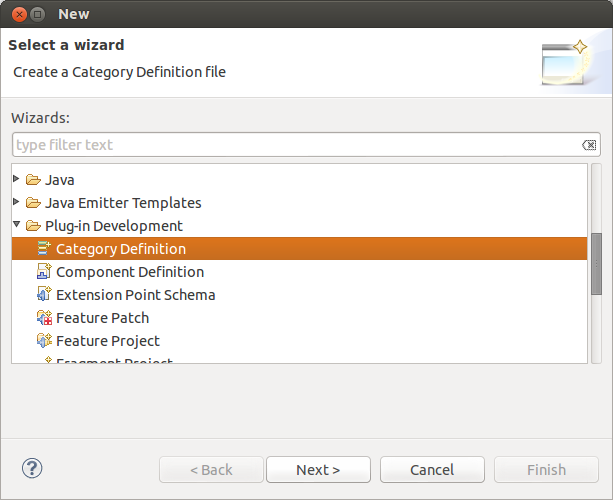
Press the New Category button and create a category with a name which describes your functionality. Add your feature to this category.
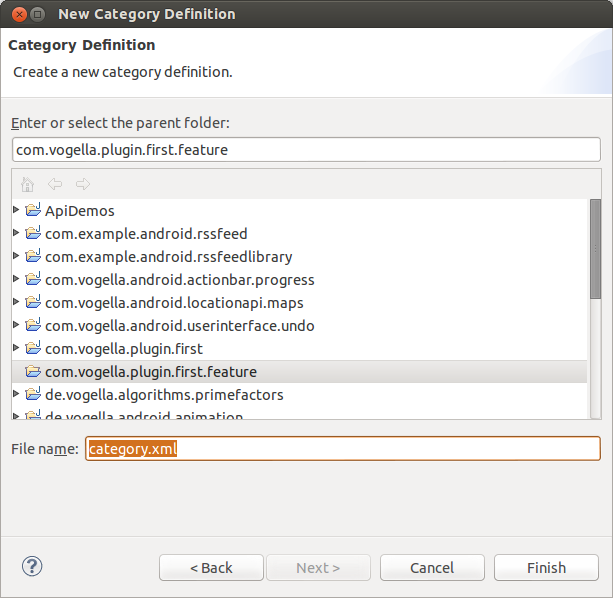
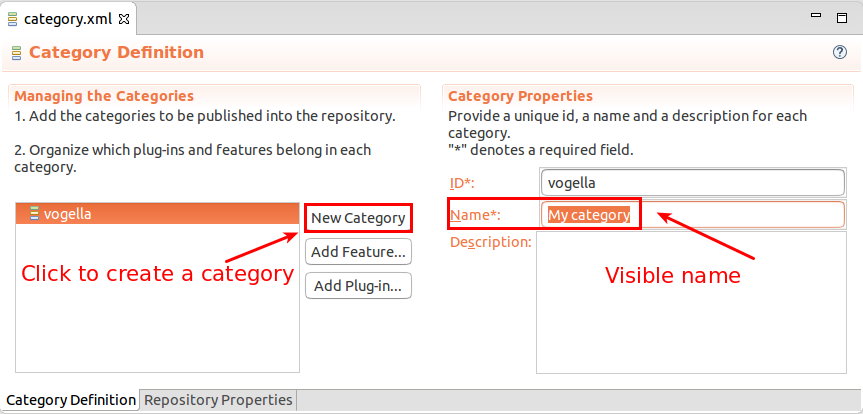
21. Exercise: Create an update site your plug-in
21.1. Create an update site
You can create an update site for your feature in a local directory on your machine. For this, select
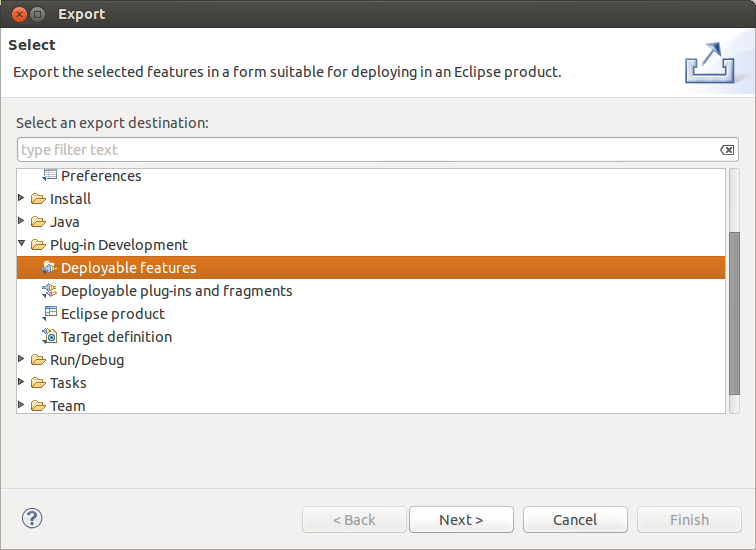
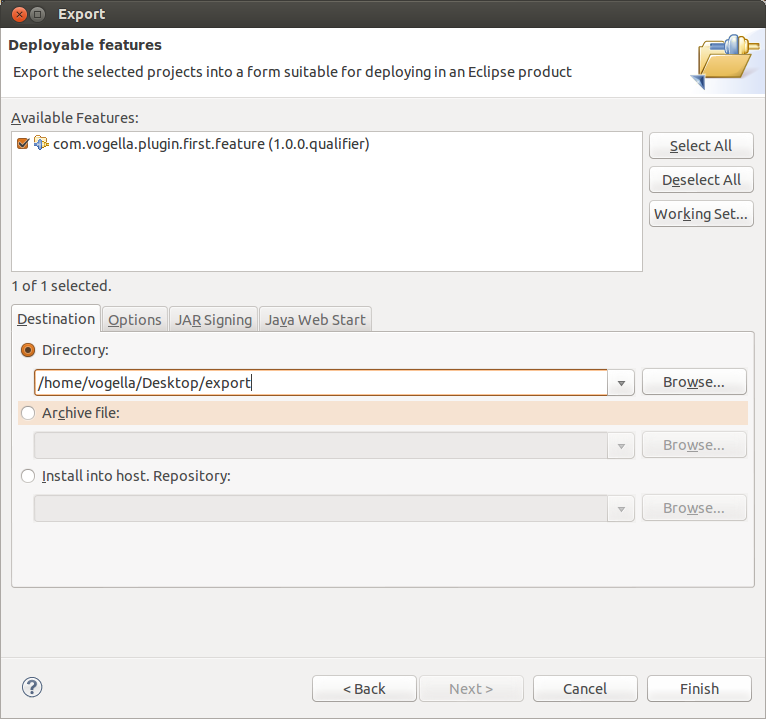
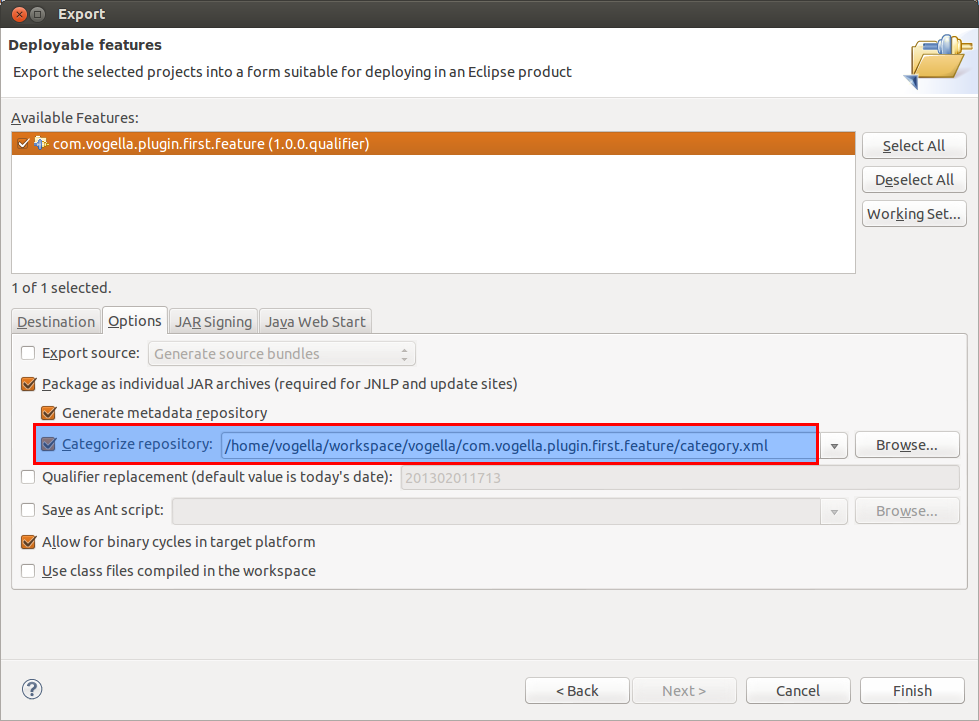
To use your category, switch to the Options tab and select the path to your category.xml file in the Categorize repository option.
21.2. Install feature via the Eclipse update manager
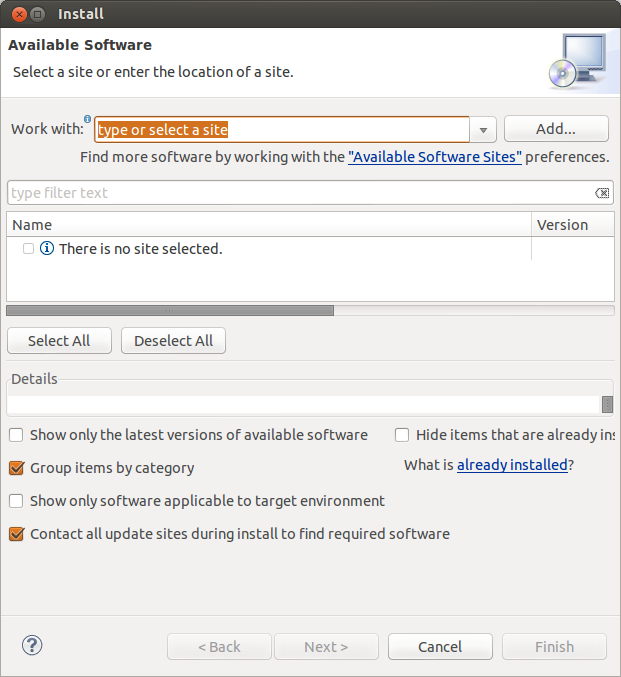
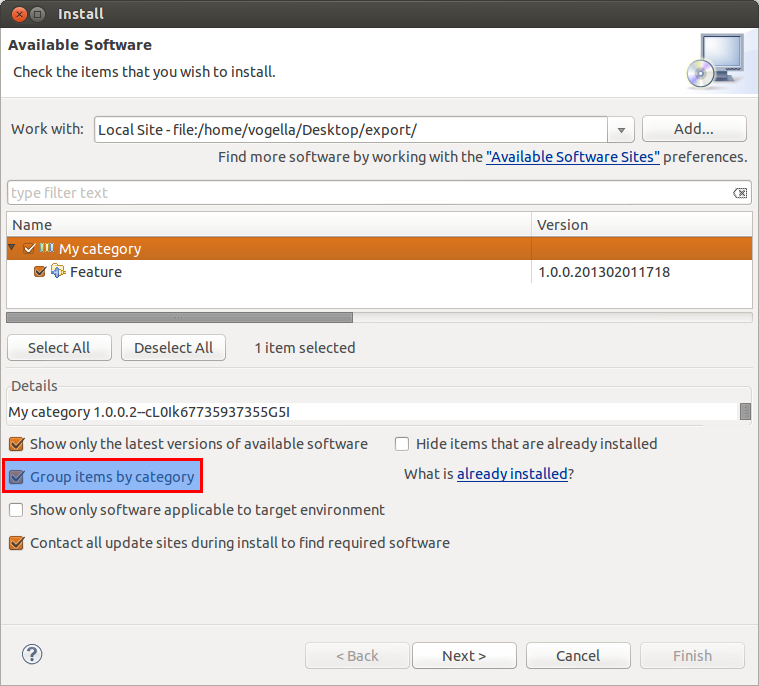
Use the Eclipse update manager via to install this new feature into your Eclipse IDE.
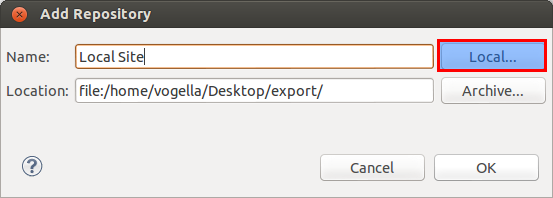
Use the update manager to point to your local directory. Then select and install your feature. In case you don't see your feature, try deselecting the Group items by category flag. In this case, you have forgotten to set your category during the export.
| If you put the resulting files on a webserver under a public accessible URL, your users could install your features from this URL. |
21.3. Validate installation
Restart the Eclipse IDE after the installation. Ensure that your plug-in is available in your Eclipse installation and can be used.

How To Create A Plugin For Eclipse
Source: https://www.vogella.com/tutorials/EclipsePlugin/article.html
Posted by: millerforcer.blogspot.com
0 Response to "How To Create A Plugin For Eclipse"
Post a Comment