

Which Zone Damper Draws More Voltage

Opposed blade dampers in a mixing duct.
A damper is a valve or plate that stops or regulates the flow of air inside a duct, chimney, VAV box, air handler, or other air-handling equipment. A damper may be used to cut off primal air conditioning (heating or cooling) to an unused room, or to regulate it for room-by-room temperature and climate control. Its performance can be manual or automatic. Manual dampers are turned by a handle on the exterior of a duct. Automated dampers are used to regulate airflow constantly and are operated by electric or pneumatic motors, in plough controlled past a thermostat or edifice automation system. Automatic or motorized dampers may also be controlled by a solenoid, and the degree of air-flow calibrated, perhaps according to signals from the thermostat going to the actuator of the damper in order to modulate the flow of air-conditioned air in order to effect climate control.[i]
In a chimney flue, a damper closes off the flue to keep the conditions (and birds and other animals) out and warm or cool air in. This is usually done in the summer, only also sometimes in the winter between uses. In some cases, the damper may also be partly closed to assist control the rate of combustion. The damper may exist accessible only past reaching upward into the fireplace by manus or with a woodpoker, or sometimes by a lever or knob that sticks down or out. On a wood-called-for stove or similar device, information technology is unremarkably a handle on the vent duct as in an ac organization. Forgetting to open a damper before commencement a burn tin crusade serious smoke damage to the interior of a home, if non a house fire.
Automated zone dampers [edit]

An opposed-bract, motor-closed, motor-opened zone damper. The damper is shown in the "open up" position.
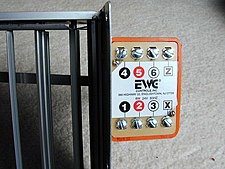
Close-up of the motor connections. This damper can switch the electrical power to control additional "slave" dampers, minimizing the electrical load on the damper's control circuitry and power transformer
A zone damper (likewise known as a Volume Control Damper or VCD) is a specific type of damper used to command the period of air in an HVAC heating or cooling system. In guild to improve efficiency and occupant comfort, HVAC systems are commonly divided upward into multiple zones. For example, in a business firm, the primary flooring may be served by 1 heating zone while the upstairs bedrooms are served by another. In this way, the heat tin be directed principally to the principal flooring during the day and principally to the bedrooms at nighttime, allowing the unoccupied areas to absurd down.
Zone dampers equally used in habitation HVAC systems are unremarkably electrically powered. In large commercial installations, vacuum or compressed air may be used instead. In either case, the motor is usually connected to the damper via a mechanical coupling.
For electrical zone dampers, there are two principal designs.
In i design, the motor is often a small shaded-pole synchronous motor combined with a rotary switch that can disconnect the motor at either of the two stopping points ("damper open" or "damper closed"). In this fashion, applying power to the "open damper" terminal causes the motor to run until the damper is open while applying power at the "close damper" last causes the motor to run until the damper is closed. The motor is ordinarily powered from the same 24 volt Air-conditioning ability source that is used for the residuum of the command system. This allows the zone dampers to be directly controlled past low-voltage thermostats and wired with low-voltage wiring. Considering simultaneous closure of all dampers might harm the furnace or air handler, this style of damper is often designed to but obstruct a portion of the air duct, for example, 75%.
Some other manner of electrically powered damper uses a bound-return mechanism and a shaded-pole synchronous motor. In this case, the damper is usually opened by the force of the spring but can be closed by the strength of the motor. Removal of electrical ability re-opens the damper. This style of damper is advantageous because it is "fail safe"; if the command to the damper fails, the damper opens and allows air to flow. However, in most applications "fail safe" indicates the damper volition close upon loss of power thus preventing the spread of smoke and fire to other areas. These dampers as well may permit adjustment of the "closed" position so that they only obstruct, for case, 75% of the air flow when airtight.
For vacuum-operated or pneumatically operated zone dampers, the thermostat usually switches the force per unit area or vacuum on or off, causing a spring-loaded rubber diaphragm to move and activate the damper. Equally with the second style of electrical zone dampers, these dampers automatically render to the default position without the application of any power, and the default position is unremarkably "open", allowing air to flow. Like the second fashion of electrical zone damper, these dampers may permit aligning of the "closed" position.
Highly sophisticated systems may use some form of building automation such as BACnet or LonWorks to control the zone dampers. The dampers may also support positions other than fully open or fully closed and are commonly capable of reporting their current position and, oftentimes, the temperature and book of the air flowing past the smart damper.
Regardless of the style of damper employed, the systems are often designed so that when no thermostat is calling for air, all dampers in the system are opened. This allows air to keep to flow while the oestrus exchanger in a furnace cools down subsequently a heating period completes.
Comparing to multiple furnaces/air handlers [edit]
Multiple zones tin be implemented using either multiple, individually controlled furnaces/air handlers or a single furnace/air handler and multiple zone dampers. Each approach has advantages and disadvantages.
Multiple furnaces/air handlers [edit]
Advantages:
- Simple mechanical and control design ("SPST thermostats")
- Redundancy: If one zone furnace fails, the others tin can remain working
Disadvantages:
- Cost. Furnaces toll much more than than zone dampers
- Power consumption. Operating furnaces describe power whereas a zone damper just draws power while in motion from ane country to the other (or, in some cases, a very small corporeality of power while property closed)
Zone dampers [edit]
Advantages:
- Cost.
- Power consumption.
Disadvantages:
- New United states residential building codes require permanent access to dampers through ceiling access panels.
- Zone dampers are non 100% reliable. Most styles of motor-to-open/motor-to-closed electrically operated zone dampers aren't "neglect safe" (that is, they do not fail to the open up condition). However, zone dampers that are of the "Normally Open up" blazon are fail-rubber, in that they volition neglect to the open condition.
- No inherent redundancy for the furnace. A organization with zone dampers is dependent upon a single furnace. If it fails, the system becomes completely inoperable.
- Depression total flow when merely some dampers are open can crusade inefficient operation.
- Supply and render ducts need dampers to avert pressurization of portions of the building.
- The organisation can exist harder to a design, requiring both "SPDT" thermostats (or relays) and the power of the system to withstand the fault condition whereby all zone dampers are closed simultaneously.
Pneumatic actuation is preferred for these dampers. Information technology is easier to provide zone-classified solenoid valves for pneumatic actuation, as compared to electrical actuation. The concrete size of such solenoid valves take come downward very considerably over the years.
Burn down dampers [edit]
Burn dampers are fitted where ductwork passes through burn compartment walls and fire curtains as function of a fire command strategy. In normal circumstances, these dampers are held open by ways of fusible links. When subjected to heat, these links fracture and allow the damper to close under the influence of the integral endmost spring. The links are attached to the damper such that the dampers tin can be released manually for testing purposes. The damper is provided with an access door in the side by side ductworks for the purpose of inspection and resetting in the event of closure.
Run into also [edit]
- Zone valve
- Variable air volume (VAV)
- Testing, adjusting, balancing
- Air-mixing plenum
References [edit]
- ^ What are Dampers?
External links [edit]
 Media related to Air dampers at Wikimedia Commons

Source: https://en.wikipedia.org/wiki/Damper_%28flow%29
Posted by: millerforcer.blogspot.com
0 Response to "Which Zone Damper Draws More Voltage"
Post a Comment