

What Does The Data In Table 1 Show About The Makeup Of Dna For Different Species?
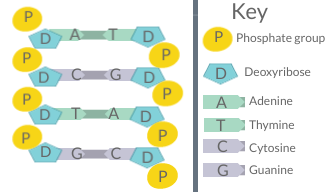
A diagram of DNA base of operations pairing, demonstrating the footing for Chargaff'due south rules.
Chargaff's rules state that Deoxyribonucleic acid from whatsoever species of any organism should have a ane:1 stoichiometric ratio of purine and pyrimidine bases (i.e., A+G=T+C) and, more specifically, that the corporeality of guanine should be equal to cytosine and the corporeality of adenine should be equal to thymine. This pattern is found in both strands of the Dna. They were discovered past Austrian-born chemist Erwin Chargaff,[1] [ii] in the belatedly 1940s.
Definitions [edit]
Beginning parity rule [edit]
The get-go rule holds that a double-stranded Dna molecule, globally has pct base pair equality: A% = T% and G% = C%. The rigorous validation of the rule constitutes the footing of Watson-Crick pairs in the Dna double helix model.
Second parity rule [edit]
The second rule holds that both Α%≈ Τ% and G% ≈ C% are valid for each of the 2 Deoxyribonucleic acid strands.[three] This describes only a global feature of the base composition in a single DNA strand.[iv]
Research [edit]
The 2d parity rule was discovered in 1968.[3] It states that, in unmarried-stranded Deoxyribonucleic acid, the number of adenine units is approximately equal to that of thymine (%A ≈ %T), and the number of cytosine units is approximately equal to that of guanine (%C ≈ %Yard).
The beginning empirical generalization of Chargaff's second parity rule, chosen the Symmetry Principle, was proposed past Vinayakumar V. Prabhu [5] in 1993. This principle states that for whatsoever given oligonucleotide, its frequency is approximately equal to the frequency of its complementary opposite oligonucleotide. A theoretical generalization[6] was mathematically derived by Michel E. B. Yamagishi and Roberto H. Herai in 2011.[7]
In 2006, it was shown that this rule applies to four[ii] of the five types of double stranded genomes; specifically it applies to the eukaryotic chromosomes, the bacterial chromosomes, the double stranded Deoxyribonucleic acid viral genomes, and the archaeal chromosomes.[8] It does non utilize to organellar genomes (mitochondria and plastids) smaller than ~20-30 kbp, nor does it apply to single stranded Deoxyribonucleic acid (viral) genomes or any type of RNA genome. The basis for this rule is all the same under investigation, although genome size may play a function.
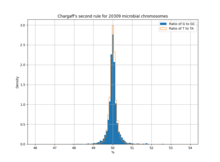
Histogram showing how 20309 chromosomes adhere to Chargaff's 2d parity dominion
The dominion itself has consequences. In most bacterial genomes (which are generally 80-90% coding) genes are arranged in such a fashion that approximately 50% of the coding sequence lies on either strand. Wacław Szybalski, in the 1960s, showed that in bacteriophage coding sequences purines (A and G) exceed pyrimidines (C and T).[nine] This rule has since been confirmed in other organisms and should probably be now termed "Szybalski'south rule". While Szybalski's dominion generally holds, exceptions are known to be.[ten] [eleven] [12] The biological basis for Szybalski'due south rule, like Chargaff'due south, is non even so known.
The combined effect of Chargaff's second dominion and Szybalski's rule can be seen in bacterial genomes where the coding sequences are not equally distributed. The genetic lawmaking has 64 codons of which 3 function as termination codons: there are only xx amino acids normally nowadays in proteins. (There are two uncommon amino acids—selenocysteine and pyrrolysine—found in a limited number of proteins and encoded by the end codons—TGA and TAG respectively.) The mismatch between the number of codons and amino acids allows several codons to code for a unmarried amino acrid - such codons normally differ only at the tertiary codon base position.
Multivariate statistical analysis of codon use within genomes with unequal quantities of coding sequences on the two strands has shown that codon use in the third position depends on the strand on which the gene is located. This seems likely to be the result of Szybalski's and Chargaff'due south rules. Because of the asymmetry in pyrimidine and purine use in coding sequences, the strand with the greater coding content will tend to take the greater number of purine bases (Szybalski'southward rule). Because the number of purine bases will, to a very practiced approximation, equal the number of their complementary pyrimidines within the aforementioned strand and, because the coding sequences occupy lxxx-ninety% of the strand, there appears to be (ane) a selective pressure level on the third base to minimize the number of purine bases in the strand with the greater coding content; and (2) that this pressure is proportional to the mismatch in the length of the coding sequences between the ii strands.
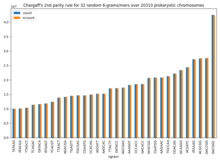
Chargaff'due south second parity rule for prokaryotic 6-mers
The origin of the divergence from Chargaff's rule in the organelles has been suggested to be a consequence of the mechanism of replication.[13] During replication the Dna strands separate. In unmarried stranded DNA, cytosine spontaneously slowly deaminates to adenosine (a C to A transversion). The longer the strands are separated the greater the quantity of deamination. For reasons that are not however clear the strands tend to be longer in single form in mitochondria than in chromosomal Dna. This process tends to yield 1 strand that is enriched in guanine (Thousand) and thymine (T) with its complement enriched in cytosine (C) and adenosine (A), and this process may accept given ascension to the deviations found in the mitochondria.[ citation needed ] [ dubious ]
Chargaff's 2d rule appears to be the consequence of a more than complex parity rule: within a unmarried strand of DNA whatever oligonucleotide (k-mer or n-gram; length ≤ 10) is present in equal numbers to its reverse complementary nucleotide. Because of the computational requirements this has not been verified in all genomes for all oligonucleotides. Information technology has been verified for triplet oligonucleotides for a large data prepare.[14] Albrecht-Buehler has suggested that this dominion is the consequence of genomes evolving by a procedure of inversion and transposition.[14] This process does not appear to take acted on the mitochondrial genomes. Chargaff'due south 2d parity rule appears to be extended from the nucleotide-level to populations of codon triplets, in the case of whole single-stranded Human genome Dna.[xv] A kind of "codon-level second Chargaff's parity rule" is proposed as follows:
| First codon | Second codon | Relation proposed | Details |
|---|---|---|---|
Twx (1st base position is T) | yzA (3rd base of operations position is A) | % Twx % yzA | Twx and yzA are mirror codons, eastward.g. TCG and CGA |
Cwx (1st base position is C) | yzG (3rd base position is 1000) | % Cwx % yzG | Cwx and yzG are mirror codons, e.g. CTA and TAG |
wTx (2nd base position is T) | yAz (second base of operations position is A) | % wTx % yAz | wTx and yAz are mirror codons, eastward.yard. CTG and CAG |
wCx (2nd base position is C) | yGz (second base position is G) | % wCx % yGz | wCx and yGz are mirror codons, e.g. TCT and AGA |
wxT (tertiary base position is T) | Ayz (1st base position is A) | % wxT % Ayz | wxT and Ayz are mirror codons, eastward.1000. CTT and AAG |
wxC (3rd base position is C) | Gyz (1st base of operations position is M) | % wxC % Gyz | wxC and Gyz are mirror codons, e.g. GGC and GCC |

Examples — computing whole human genome using the commencement codons reading frame provides:
36530115 TTT and 36381293 AAA (ratio % = 1.00409). 2087242 TCG and 2085226 CGA (ratio % = 1.00096), etc...
In 2020, it is suggested that the physical properties of the dsDNA (double stranded DNA) and the trend to maximum entropy of all the physical systems are the crusade of Chargaff's 2nd parity rule.[16] The symmetries and patterns present in the dsDNA sequences tin can emerge from the physical peculiarities of the dsDNA molecule and the maximum entropy principle solitary, rather than from biological or environmental evolutionary force per unit area.
Percentages of bases in Dna [edit]
The following tabular array is a representative sample of Erwin Chargaff's 1952 data, listing the base limerick of DNA from diverse organisms and support both of Chargaff'due south rules.[17] An organism such as φX174 with significant variation from A/T and K/C equal to one, is indicative of single stranded Deoxyribonucleic acid.
| Organism | Taxon | %A | %Chiliad | %C | %T | A / T | G / C | %GC | %AT |
|---|---|---|---|---|---|---|---|---|---|
| Maize | Zea | 26.8 | 22.8 | 23.2 | 27.two | 0.99 | 0.98 | 46.one | 54.0 |
| Octopus | Octopus | 33.ii | 17.vi | 17.half dozen | 31.6 | 1.05 | 1.00 | 35.two | 64.eight |
| Chicken | Gallus | 28.0 | 22.0 | 21.half dozen | 28.4 | 0.99 | 1.02 | 43.7 | 56.iv |
| Rat | Rattus | 28.vi | 21.4 | 20.5 | 28.4 | i.01 | one.00 | 42.nine | 57.0 |
| Human being | Homo | 29.3 | twenty.seven | 20.0 | 30.0 | 0.98 | 1.04 | twoscore.7 | 59.3 |
| Grasshopper | Orthoptera | 29.3 | 20.5 | 20.7 | 29.three | ane.00 | 0.99 | 41.2 | 58.6 |
| Sea urchin | Echinoidea | 32.8 | 17.7 | 17.3 | 32.i | i.02 | 1.02 | 35.0 | 64.9 |
| Wheat | Triticum | 27.3 | 22.7 | 22.8 | 27.ane | ane.01 | ane.00 | 45.5 | 54.iv |
| Yeast | Saccharomyces | 31.3 | 18.7 | 17.1 | 32.9 | 0.95 | 1.09 | 35.eight | 64.4 |
| E. coli | Escherichia | 24.7 | 26.0 | 25.vii | 23.6 | 1.05 | ane.01 | 51.7 | 48.iii |
| φX174 | PhiX174 | 24.0 | 23.iii | 21.v | 31.ii | 0.77 | 1.08 | 44.eight | 55.2 |
See likewise [edit]
- Genetic codes
References [edit]
- ^ Elson D, Chargaff E (1952). "On the deoxyribonucleic acid content of sea urchin gametes". Experientia. eight (iv): 143–145. doi:10.1007/BF02170221. PMID 14945441. S2CID 36803326.
- ^ a b Chargaff E, Lipshitz R, Light-green C (1952). "Composition of the deoxypentose nucleic acids of four genera of sea-urchin". J Biol Chem. 195 (1): 155–160. doi:10.1016/S0021-9258(xix)50884-5. PMID 14938364. S2CID 11358561.
- ^ a b Rudner, R; Karkas, JD; Chargaff, Due east (1968). "Separation of B. Subtilis Dna into complementary strands. 3. Direct analysis". Proceedings of the National Academy of Sciences of the United states. sixty (three): 921–ii. Bibcode:1968PpAS...60..921R. doi:10.1073/pnas.lx.3.921. PMC225140. PMID 4970114.
- ^ Zhang CT, Zhang R, Ou HY (2003). "The Z bend database: a oraphic representation of genome sequences". Bioinformatics. 19 [issue=v (5): 590–599. doi:10.1093/bioinformatics/btg041. PMID 12651717.
- ^ Prabhu VV (1993). "Symmetry observation in long nucleotide sequences". Nucleic Acids Enquiry. 21 (12): 2797–2800. doi:x.1093/nar/21.12.2797. PMC309655. PMID 8332488.
- ^ Yamagishi MEB (2017). Mathematical Grammar of Biology. SpringerBriefs in Mathematics. Springer. arXiv:1112.1528. doi:10.1007/978-3-319-62689-five. ISBN978-iii-319-62688-eight. S2CID 16742066.
- ^ Yamagishi MEB, Herai RH (2011). Chargaff's "Grammar of Biology": New Fractal-like Rules. SpringerBriefs in Mathematics. arXiv:1112.1528. doi:10.1007/978-three-319-62689-5. ISBN978-iii-319-62688-8. S2CID 16742066.
{{cite volume}}: CS1 maint: uses authors parameter (link) - ^ Mitchell D, Span R (2006). "A exam of Chargaff's second rule". Biochem Biophys Res Commun. 340 (ane): 90–94. doi:10.1016/j.bbrc.2005.eleven.160. PMID 16364245.
- ^ Szybalski W, Kubinski H, Sheldrick O (1966). "Pyrimidine clusters on the transcribing strand of Deoxyribonucleic acid and their possible office in the initiation of RNA synthesis". Common cold Jump Harb Symp Quant Biol. 31: 123–127. doi:x.1101/SQB.1966.031.01.019. PMID 4966069.
- ^ Cristillo AD (1998). Characterization of G0/G1 switch genes in cultured T lymphocytes. PhD thesis. Kingston, Ontario, Canada: Queen's University.
- ^ Bell SJ, Forsdyke DR (1999). "Deviations from Chargaff's second parity dominion correlate with direction of transcription". J Theor Biol. 197 (i): 63–76. Bibcode:1999JThBi.197...63B. doi:10.1006/jtbi.1998.0858. PMID 10036208.
- ^ Lao PJ, Forsdyke DR (2000). "Thermophilic Bacteria Strictly Obey Szybalski's Transcription Direction Rule and Politely Purine-Load RNAs with Both Adenine and Guanine". Genome Enquiry. 10 (2): 228–236. doi:10.1101/gr.10.2.228. PMC310832. PMID 10673280.
- ^ Nikolaou C, Almirantis Y (2006). "Deviations from Chargaff'due south second parity rule in organellar DNA. Insights into the evolution of organellar genomes". Gene. 381: 34–41. doi:10.1016/j.gene.2006.06.010. PMID 16893615.
- ^ a b Albrecht-Buehler G (2006). "Asymptotically increasing compliance of genomes with Chargaff's second parity rules through inversions and inverted transpositions". Proc Natl Acad Sci USA. 103 (47): 17828–17833. Bibcode:2006PNAS..10317828A. doi:10.1073/pnas.0605553103. PMC1635160. PMID 17093051.
- ^ Perez, J.-C. (September 2010). "Codon populations in single-stranded whole man genome DNA are fractal and fine-tuned by the Golden Ratio 1.618". Interdisciplinary Sciences: Computational Life Scientific discipline. ii (3): 228–240. doi:10.1007/s12539-010-0022-0. PMID 20658335. S2CID 54565279.
- ^ Piero Farisell, Cristian Taccioli, Luca Pagani & Amos Maritan (April 2020). "Deoxyribonucleic acid sequence symmetries from randomness: the origin of the Chargaff's second parity rule". Briefings in Bioinformatics. 22 (bbaa04): 2172–2181. doi:10.1093/bib/bbaa041. PMC7986665. PMID 32266404.
{{cite periodical}}: CS1 maint: multiple names: authors listing (link) - ^ Bansal Yard (2003). "DNA construction: Revisiting the Watson-Crick double helix" (PDF). Electric current Science. 85 (11): 1556–1563. Archived from the original (PDF) on 2014-07-26. Retrieved 2013-07-26 .
Farther reading [edit]
- Szybalski W, Kubinski H, Sheldrick P (1966). "Pyrimidine clusters on the transcribing strands of DNA and their possible office in the initiation of RNA synthesis". Cold Spring Harbor Symposia on Quantitative Biology. 31: 123–127. doi:10.1101/SQB.1966.031.01.019. PMID 4966069.
- Lobry JR (1996). "Asymmetric exchange patterns in the ii Dna strands of leaner". Mol. Biol. Evol. xiii (5): 660–665. doi:ten.1093/oxfordjournals.molbev.a025626. PMID 8676740.
- Lafay B, Lloyd AT, McLean MJ, Devine KM, Sharp PM, Wolfe KH (1999). "Proteome composition and codon usage in spirochaetes: species-specific and Dna strand-specific mutational biases". Nucleic Acids Res. 27 (7): 1642–1649. doi:x.1093/nar/27.7.1642. PMC148367. PMID 10075995.
- McLean MJ, Wolfe KH, Devine KM (1998). "Base composition skews, replication orientation, and gene orientation in 12 prokaryote genomes". J Mol Evol. 47 (6): 691–696. Bibcode:1998JMolE..47..691M. CiteSeerX10.one.1.28.9035. doi:10.1007/PL00006428. PMID 9847411. S2CID 12917481.
- McInerney JO (1998). "Replicational and transcriptional selection on codon usage in Borrelia burgdorferi". Proc Natl Acad Sci United states of america. 95 (xviii): 10698–10703. Bibcode:1998PNAS...9510698M. doi:10.1073/pnas.95.18.10698. PMC27958. PMID 9724767.
External links [edit]
- CBS Genome Atlas Database — contains hundreds of examples of base skews and had problems.[1]
- The Z curve database of genomes — a 3-dimensional visualization and analysis tool of genomes.[two]
- ^ Hallin PF, David Ussery D (2004). "CBS Genome Atlas Database: A dynamic storage for bioinformatic results and sequence data". Bioinformatics. xx (18): 3682–3686. doi:ten.1093/bioinformatics/bth423. PMID 15256401.
- ^ Zhang CT, Zhang R, Ou HY (2003). "The Z curve database: a graphic representation of genome sequences". Bioinformatics. 19 (v): 593–599. doi:ten.1093/bioinformatics/btg041. PMID 12651717.

What Does The Data In Table 1 Show About The Makeup Of Dna For Different Species?,
Source: https://en.wikipedia.org/wiki/Chargaff%27s_rules
Posted by: millerforcer.blogspot.com
0 Response to "What Does The Data In Table 1 Show About The Makeup Of Dna For Different Species?"
Post a Comment